How Darkvision and Light Work in 5e
Darkvision lets you see Dim Light as Bright Light and Darkness as Dim Light within its range, so in the dark you still have Disadvantage on Wisdom (Perception) checks that rely on sight. The dungeon door opens on black. One player lights a torch, the Dwarf says "I have Darkvision", and the GM has to decide who sees what. SRD 5.2.1 settles it in under a page, and most tables get Darkvision wrong. Here are the rules, quoted, with the dice worked out.
Two kinds of obscured
In a Lightly Obscured area—such as an area with Dim Light, patchy fog, or moderate foliage—you have Disadvantage on Wisdom (Perception) checks that rely on sight.
A Heavily Obscured area—such as an area with Darkness, heavy fog, or dense foliage—is opaque. You have the Blinded condition (see "Rules Glossary") when trying to see something there.
Lightly Obscured costs you a die on Perception. Heavily Obscured blinds you, for that one thing you're trying to see.
Three levels of light
Bright Light lets most creatures see normally.
Dim Light, also called shadows, creates a Lightly Obscured area. An area of Dim Light is usually a boundary between Bright Light and surrounding Darkness.
Darkness creates a Heavily Obscured area. Characters face Darkness outdoors at night (even most moonlit nights), within the confines of an unlit dungeon, or in an area of magical Darkness.
Note "even most moonlit nights". A full moon "might bathe the land in Dim Light", but an ordinary night is Darkness.
What Blinded costs
Can't See. You can't see and automatically fail any ability check that requires sight.
Attacks Affected. Attack rolls against you have Advantage, and your attack rolls have Disadvantage.
The combat rules say the same from the other side:
When you make an attack roll against a target you can't see, you have Disadvantage on the roll. [...] When a creature can't see you, you have Advantage on attack rolls against it.
Darkvision is Dim Light, not daylight
If you have Darkvision, you can see in Dim Light within a specified range as if it were Bright Light and in Darkness within that range as if it were Dim Light. You discern colors in that Darkness only as shades of gray.
Darkvision moves each zone up one step, and Dim Light is still Lightly Obscured. So a Dwarf walking an unlit tunnel can see, can fight, and still has Disadvantage on every Perception check that relies on sight.
Take a Dwarf with Perception +3 looking for a tripwire at DC 15. In torchlight the check needs a 12: 45%. In Darkness with Darkvision it rolls twice and keeps the lower: 0.45 × 0.45 = 20.25%. A Human with no light fails automatically.
Ranges from the SRD's species: Dragonborn, Elf, Gnome and Tiefling see 60 feet; Dwarf and Orc 120 feet; a Drow's "Darkvision increases to 120 feet." The Darkvision spell grants 150 feet for 8 hours.
How far the light reaches
| Source | Bright | Dim beyond | Lasts |
|---|---|---|---|
| Candle | 5 ft | 5 ft | 1 hour |
| Torch | 20 ft | 20 ft | 1 hour |
| Lamp | 15 ft | 30 ft | 6 hours per Oil |
| Hooded Lantern | 30 ft | 30 ft | 6 hours per Oil |
| Bullseye Lantern | 60 ft cone | 60 ft | 6 hours per Oil |
| Light cantrip | 20 ft | 20 ft | 1 hour |
A flask of Oil "burns for 6 hours in a Lamp or Lantern", and "That duration doesn't need to be consecutive". The Hooded Lantern has a trick worth knowing: "As a Bonus Action, you can lower the hood, reducing the light to Dim Light in a 5-foot radius, or raise it again." The Light cantrip goes out under anything opaque: "Covering the object with something opaque blocks the light."
Why the torch loses the first exchange
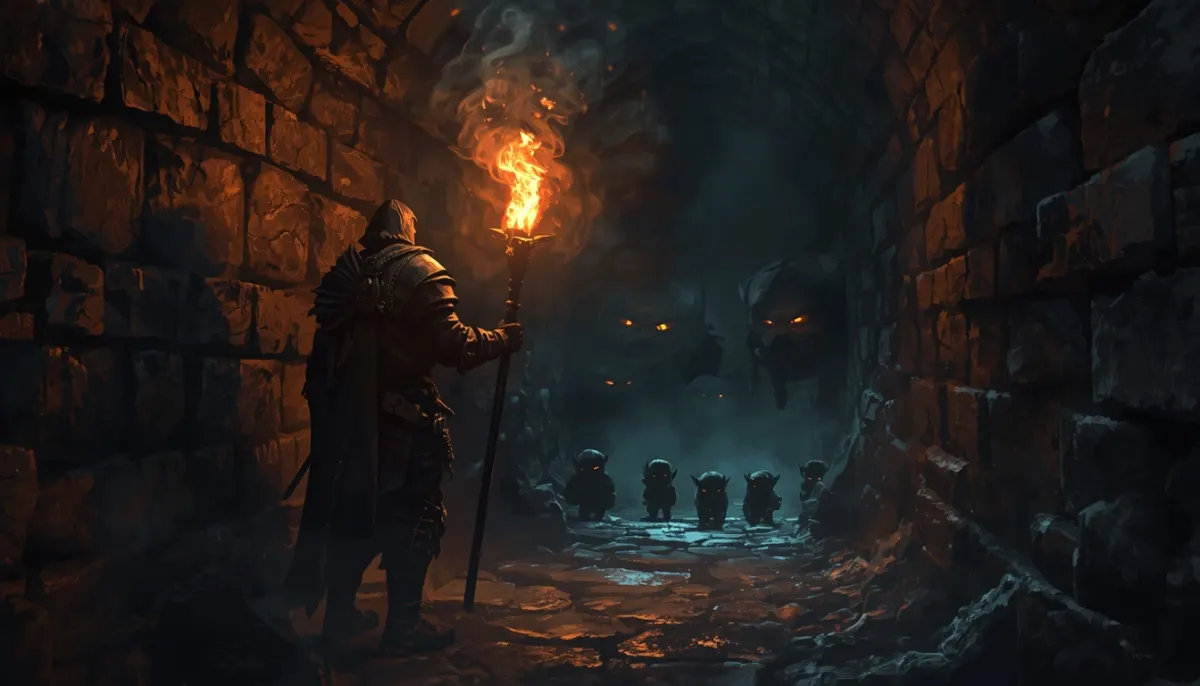
Goblin Warriors carry Shortbows (+4, range 80/320 ft) and list "Senses Darkvision 60 ft." Put three of them 50 feet down a corridor, and the party's Fighter (AC 16, Chain Mail) holding a torch.
The Fighter stands in Bright Light, visible to anything with line of sight. The goblins stand 10 feet past the torch's Dim edge, in Darkness. Their Darkvision turns that Darkness into Dim Light for them, and they can see the lit party anyway. The Human Fighter can't see them at all.
So each goblin shoots at a target that can't see it. A +4 against AC 16 needs a 12: 45% from the open. With Advantage: 1 − 0.55 × 0.55 = 69.75%. And the goblin's own stat block adds "2 (1d4) Piercing damage if the attack roll had Advantage", so each hit averages 7.5 instead of 5.
Shoot back, and it reverses. The Fighter's +5 against a goblin's AC 15 needs a 10: 55% in light, 0.55 × 0.55 = 30.25% at a target unseen. The Fighter also has to guess the right square: "If the target isn't in the location you targeted, you miss."
Three fixes, all in the rules:
- Throw light forward. Drop a torch or cast Light on a stone and toss it down the corridor. Goblins inside its 20 feet stand in Bright Light, seen.
- Let the Darkvision characters lead. A Dwarf sees anything within 120 feet, so it sees the goblins as Dim Light shapes: no Disadvantage to hit, and the goblins lose their unseen Advantage.
- Darken yourselves. Lower the lantern's hood. A party in Darkness gives a goblin's Darkvision only Dim Light, and the goblins have Disadvantage to spot it too.
Magical Darkness
The Darkness spell fills a 15-foot-radius Sphere, and two lines decide every fight inside it:
Darkvision can't see through it, and nonmagical light can't illuminate it.
Inside, everyone is Blinded to everyone else, so the Advantage from an unseen attacker and the Disadvantage on attacking an unseen target cancel out. Only Blindsight ("you can see anything that isn't behind Total Cover even if you have the Blinded condition or are in Darkness") and Truesight ("You can see in normal and magical Darkness") cut through.
For the GM
Before the first roll in a dark room, settle what light each side carries, where its edges fall, and who has Darkvision. Draw the torch's 20 and 40 foot rings on the map.
The Book of Dice covers the d20 in Part I, The Object, and Advantage and Disadvantage in Part III, The Rolling.
This work includes material from the System Reference Document 5.2.1 ("SRD 5.2.1") by Wizards of the Coast LLC, available at dndbeyond.com/srd. The SRD 5.2.1 is licensed under the Creative Commons Attribution 4.0 International License.