How Does Cover Work in D&D 5e?
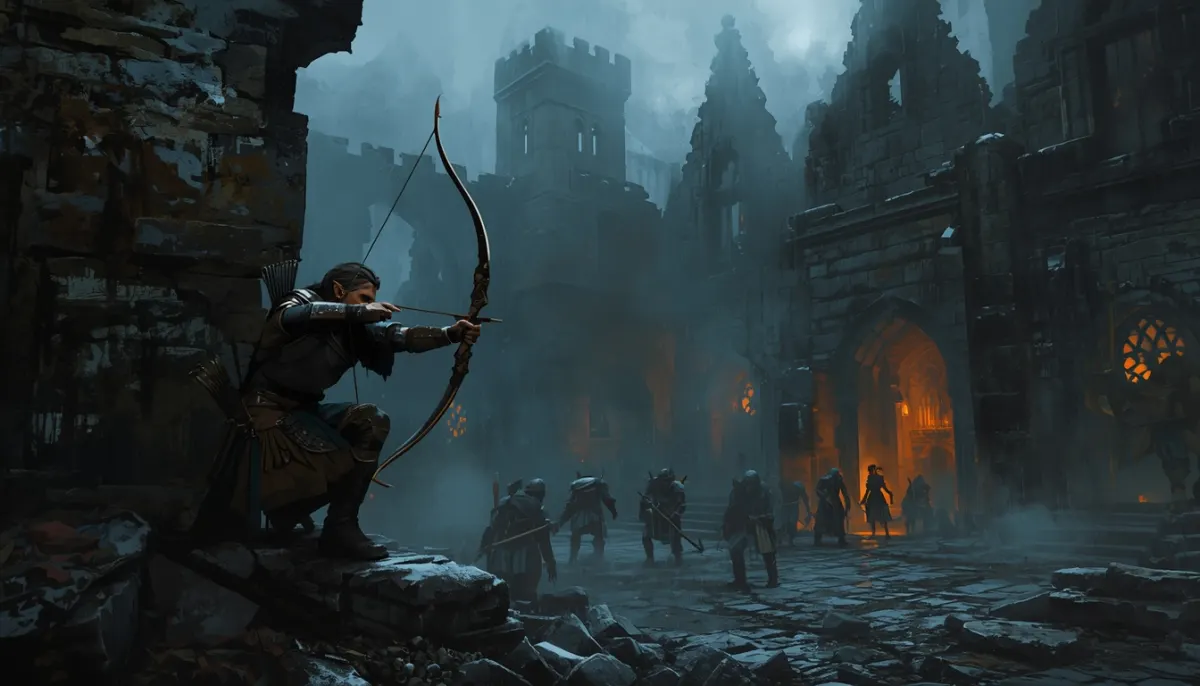
Half Cover adds +2 to a target's AC and Dexterity saving throws, Three-Quarters Cover adds +5, and Total Cover means it can't be targeted directly. Two players face the same goblin. One stands in the open; one crouches behind a wall. The rules treat them very differently, and most tables forget half of it. Here is the whole of cover and ranged attacks, from SRD 5.2.1.
Cover: three degrees
The SRD opens plainly:
Walls, trees, creatures, and other obstacles can provide cover, making a target more difficult to harm.
Cover comes in three degrees, and each one does a fixed thing:
| Degree | Benefit to target | Offered by |
|---|---|---|
| Half | +2 to AC and Dexterity saving throws | Another creature or an object covering at least half the target |
| Three-Quarters | +5 to AC and Dexterity saving throws | An object covering at least three-quarters of the target |
| Total | Can't be targeted directly | An object covering the whole target |
Two details matter at the table. First, the bonus applies to Dexterity saving throws too, so a wall helps against a blast as well as an arrow. Second, a creature only ever gives Half Cover. Your friend standing in front of you is a half-wall, never more.
Cover does not stack
If a target is behind multiple sources of cover, only the most protective degree of cover applies; the degrees aren't added together.
A goblin behind an ally and a tree trunk has Three-Quarters Cover, not +7. And the cover must sit between you: a target "can benefit from cover only when an attack or other effect originates on the opposite side of the cover."
Who decides
The attack rules give the call to the GM. Step 2 of every attack reads: "The GM determines whether the target has Cover." So ask before you roll, not after.
What +2 and +5 are worth
Take an archer with a +5 attack bonus shooting a Goblin Warrior. The SRD stat block gives it AC 15. An attack "hits if the roll equals or exceeds the target's Armor Class," so the archer needs 10 or more on the d20.
| Goblin's cover | AC | d20 needed | Chance to hit |
|---|---|---|---|
| None | 15 | 10+ | 55% |
| Half | 17 | 12+ | 45% |
| Three-Quarters | 20 | 15+ | 30% |
Half Cover takes away two hits in eleven. Three-Quarters Cover takes away almost half of them. A natural 20 still hits whatever the AC, and a natural 1 still misses.
Ranged attacks: two numbers
A bow has two ranges. The Longbow reads "Range 150/600": 150 feet normal, 600 feet long.
Your attack roll has Disadvantage when your target is beyond normal range, and you can't attack a target beyond long range.
Some ranges from the SRD weapons table:
| Weapon | Normal / long range (feet) |
|---|---|
| Dagger (thrown) | 20/60 |
| Javelin (thrown) | 30/120 |
| Sling | 30/120 |
| Shortbow | 80/320 |
| Light Crossbow | 80/320 |
| Longbow | 150/600 |
A spell with a single range has no long range at all: past it, you can't attack.
Ammunition
A bow needs arrows. "Each attack expends one piece of ammunition." After the fight, "you can spend 1 minute to recover half the ammunition (round down) you used in the fight; the rest is lost." Twenty arrows fired means ten back.
Thrown weapons need nothing extra: "you can draw that weapon as part of the attack."
Shooting with a foe beside you
When you make a ranged attack roll with a weapon, a spell, or some other means, you have Disadvantage on the roll if you are within 5 feet of an enemy who can see you and doesn't have the Incapacitated condition.
This covers spells too. A wizard with a goblin at their elbow shoots worse. The fix is a step back, and stepping away from a foe that can see you invites an Opportunity Attack unless you take the Disengage action first.
When it all piles up
Disadvantage means rolling two d20s and taking the lower. Our +5 archer, needing 10, hits 55% of the time. With Disadvantage, both dice must come up 10 or more: 0.55 × 0.55, or about 30%.
Now put the goblin at long range and behind a broken wall:
| Situation | Chance to hit |
|---|---|
| Open, normal range | 55% |
| Open, long range | 30.25% |
| Three-Quarters Cover, normal range | 30% |
| Three-Quarters Cover, long range | 9% |
Nine percent. One arrow in eleven. Long range and good cover together make a shot barely worth taking, so close the distance or go round the wall.
Use it at the table
Players: before you shoot, ask the GM two things: "What cover does it have?" and "Is it in my normal range?" Write both ranges for every weapon on your sheet. When an enemy steps next to you, switch to a melee weapon or step back.
GMs: give your goblins walls to hide behind. The Goblin Warrior's own Shortbow reads "+4, range 80/320 ft.", so it can play this game too.
The Book of Dice covers the d20 in Part I, The Object, and every way of rolling it in Part III.
This work includes material from the System Reference Document 5.2.1 ("SRD 5.2.1") by Wizards of the Coast LLC, available at dndbeyond.com/srd. The SRD 5.2.1 is licensed under the Creative Commons Attribution 4.0 International License.