
How Does the Hide Action Work in 5e?
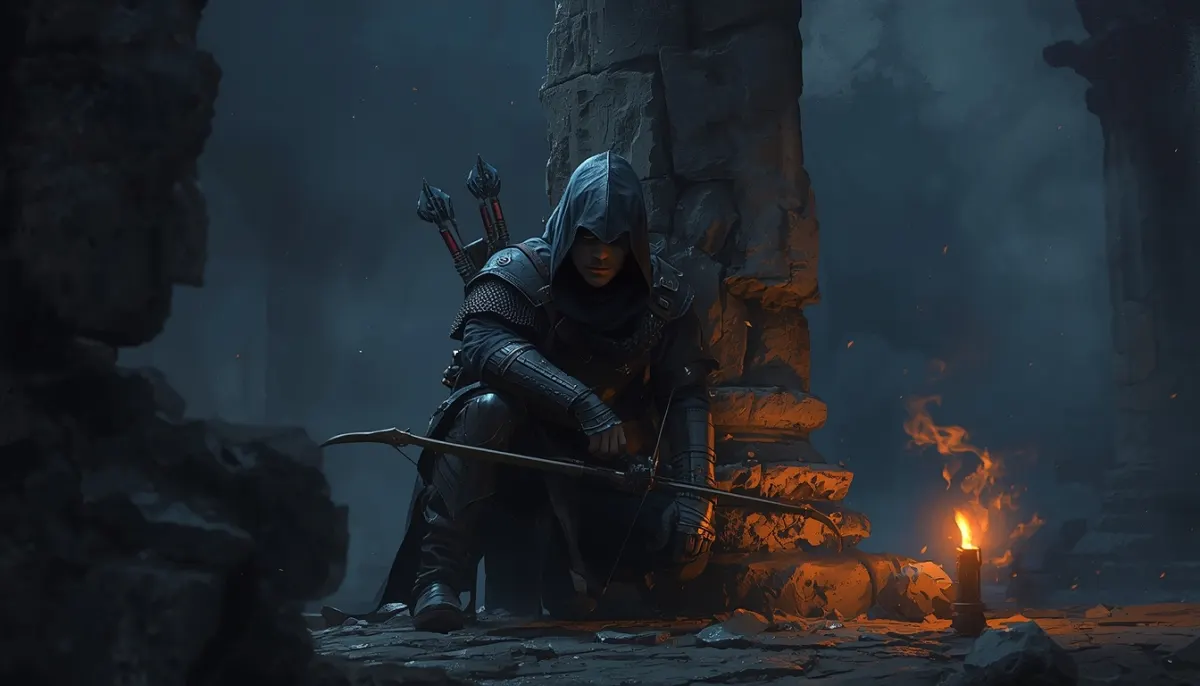
To hide, take the Hide action and pass a DC 15 Dexterity (Stealth) check while Heavily Obscured or behind Three-Quarters or Total Cover, out of every enemy's line of sight. "I hide." Every table hears it, and every table argues about it. Behind what? From whom? For how long? SRD 5.2.1 answers all three in one short glossary entry. Here it is, piece by piece, with the dice worked out.
Where you can hide
The Hide action in full starts:
With the Hide action, you try to hide yourself. To do so, you must succeed on a DC 15 Dexterity (Stealth) check while you're Heavily Obscured or behind Three-Quarters Cover or Total Cover, and you must be out of any enemy's line of sight; if you can see a creature, you can discern whether it can see you.
So three things, all at once:
- Somewhere to be. Heavily Obscured, or behind Three-Quarters or Total Cover. A low wall (Half Cover) is not enough.
- Nobody watching. Out of every enemy's line of sight. Ducking behind a crate in plain view of the guard fails before the dice come out.
- A DC 15 Stealth check. Fixed. The enemy's senses come in later.
What counts as Heavily Obscured? The SRD lists "Darkness, heavy fog, or dense foliage". Dim Light, patchy fog and moderate foliage are only Lightly Obscured: they give Disadvantage on sight-based Perception, but you can't Hide in them alone.
The roll
DC 15 is hard for most characters. Two level 2 heroes, both Dex 16 (+3); the Fighter has no Stealth proficiency:
| Hero | Stealth | d20 needs | Hides |
|---|---|---|---|
| Rogue (Expertise) | +7 | 8+ | 65% |
| Fighter | +3 | 12+ | 45% |
| Fighter in Chain Mail | +3, Disadv. | 12+ twice | 20.25% |
Expertise is the Rogue's level 1 feature, and the SRD recommends spending it here: "Sleight of Hand and Stealth are recommended if you have proficiency in them." Chain Mail's armour table entry reads "Disadvantage" under Stealth, which is why the knight in the back row stays seen.
What being hidden gives you
On a successful check, you have the Invisible condition while hidden. Make note of your check's total, which is the DC for a creature to find you with a Wisdom (Perception) check.
Two things follow. First, Invisible is a full condition. Its "Attacks Affected" line reads:
Attack rolls against you have Disadvantage, and your attack rolls have Advantage. If a creature can somehow see you, you don't gain this benefit against that creature.
It also gives Advantage on Initiative if a fight starts while you're hidden ("Surprise").
Second, your roll keeps working. The total you rolled becomes the DC to find you. A Rogue who rolls a 14 on the die has a total of 21, and a Guard (Passive Perception 12, so +2 on a Perception check) who takes the Search action needs a 19 or 20: 10%. A Rogue who scrapes a bare 15 is found by the same Guard on 13 or more: 40%. Beat the DC by as much as you can. Goblin Warriors, at Passive Perception 9, are easier to hide from still.
The four things that end it
You stop being hidden immediately after any of the following occurs: you make a sound louder than a whisper, an enemy finds you, you make an attack roll, or you cast a spell with a Verbal component.
Note the word "after". The attack that gives you away still gets the Advantage. The combat chapter says the same thing under Unseen Attackers and Targets:
If you are hidden when you make an attack roll, you give away your location when the attack hits or misses.
Moving isn't on the list. Whether a sneak across open ground in plain sight lets an enemy find you is the GM's call.
The Rogue's loop
This is why Rogues hide every turn. From level 2, Cunning Action lets a Rogue take "Dash, Disengage, or Hide" as a Bonus Action. Sneak Attack wants Advantage:
Once per turn, you can deal an extra 1d6 damage to one creature you hit with an attack roll if you have Advantage on the roll and the attack uses a Finesse or a Ranged weapon.
So a turn goes: Hide as a Bonus Action behind a pillar, then shoot from it. A Shortbow at +5 against a Goblin Warrior's AC 15 hits 55% of the time from the open. From hiding it rolls with Advantage: 1 − 0.45 × 0.45 = 79.75%, and every hit adds the Sneak Attack die. The shot reveals the Rogue, so next turn the Rogue hides again. Fail the DC 15 (35% for our +7 Rogue) and the shot still goes off, just without the Advantage, unless an ally stands within 5 feet of the goblin, which gives Sneak Attack anyway.
For the GM
The rule asks you to decide one thing: can the enemy see the hiding spot? If a creature has line of sight, the Hide fails, whatever the roll. Everything else is on the dice. Keep the Stealth total written down, and when the monsters search, roll their Perception against it rather than hand-waving.
The Book of Dice covers the d20 in Part I, The Object, and Advantage in Part III, The Rolling.
This work includes material from the System Reference Document 5.2.1 ("SRD 5.2.1") by Wizards of the Coast LLC, available at dndbeyond.com/srd. The SRD 5.2.1 is licensed under the Creative Commons Attribution 4.0 International License.