
Underwater Combat Rules in 5e
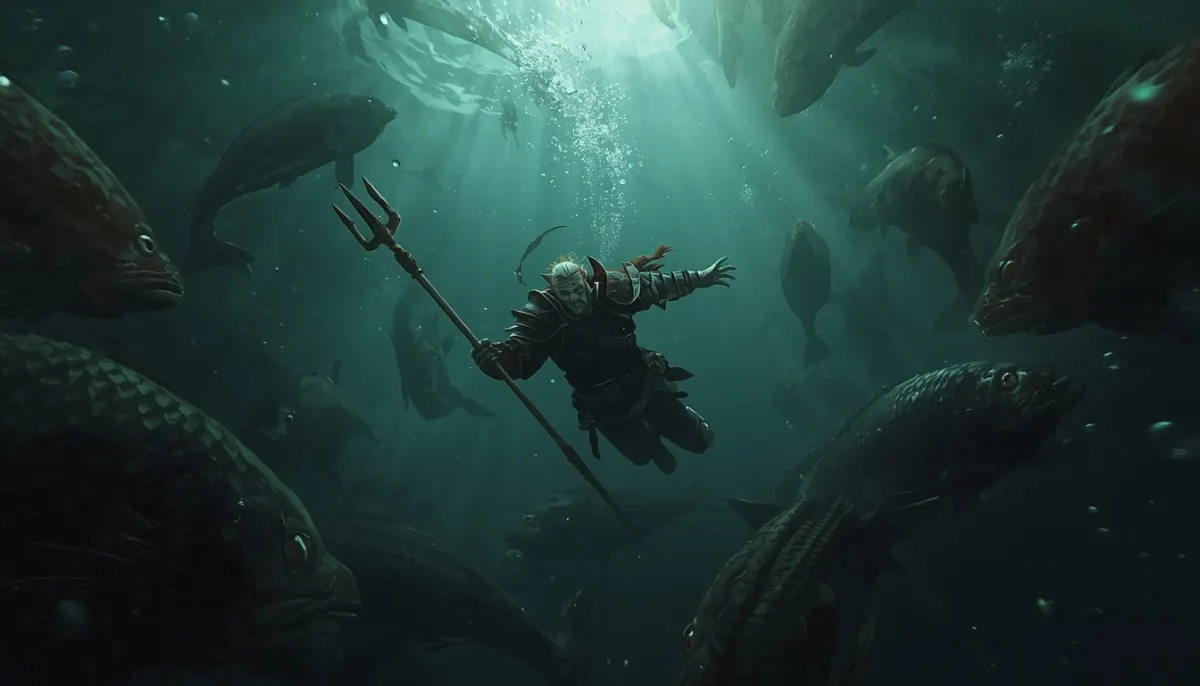
Underwater, melee weapon attacks have Disadvantage unless the weapon deals Piercing damage or you have a Swim Speed, ranged weapon attacks miss anything past normal range, and everything underwater has Resistance to Fire damage. The party dives after the sunken bell. The Fighter swings a Longsword, the Wizard casts Fire Bolt, the Ranger looses an arrow at the Sahuagin 100 feet off. All three choices go wrong. SRD 5.2.1 gives underwater combat three short rules, and the rules on swimming and breath do the rest. Here they are, quoted, with the numbers worked out.
Impeded weapons: stab, don't swing
When making a melee attack roll with a weapon underwater, a creature that lacks a Swim Speed has Disadvantage on the attack roll unless the weapon deals Piercing damage.
Two facts hide in that sentence. Piercing weapons work normally: Dagger, Rapier, Shortsword, Spear, Trident. And the rule only touches creatures without a Swim Speed. The Sahuagin Warrior has Swim 40 ft., so its Claws (Slashing) suffer nothing.
Take a Fighter with Strength 16 and an attack bonus of +5 against a Sahuagin Warrior, AC 12, 22 HP. A hit needs a 7. Averages count Critical Hits.
| Weapon | Damage | Hit chance | Average per swing |
|---|---|---|---|
| Longsword | 1d8+3 Slashing | 49% | 3.7 |
| Spear | 1d6+3 Piercing | 70% | 4.7 |
| Trident | 1d8+3 Piercing | 70% | 5.5 |
The Trident rolls the same d8 as the Longsword and keeps the full 70%. A 5 GP Trident out-damages the 15 GP sword by half again, as long as the fight stays wet.
Ranged: short range or nothing
A ranged attack roll with a weapon underwater automatically misses a target beyond the weapon's normal range, and the attack roll has Disadvantage against a target within normal range.
On land, a Shortbow reaches 320 feet with Disadvantage past 80. Underwater, 80 feet is the wall. Past each weapon's normal range, no roll: it misses.
| Weapon | Range | Underwater |
|---|---|---|
| Dagger, Spear, Trident (thrown) | 20 ft. | Disadvantage to 20 ft. |
| Shortbow, Light Crossbow | 80 ft. | Disadvantage to 80 ft. |
| Heavy Crossbow | 100 ft. | Disadvantage to 100 ft. |
| Longbow | 150 ft. | Disadvantage to 150 ft. |
The rule names no exception for Piercing, so every ranged weapon attack takes Disadvantage. A Ranger at +5 against the Sahuagin drops from 70% to 49%, and the arrow at 100 feet never lands. Close in and stab instead.
Fire burns at half
Anything underwater has Resistance to Fire damage.
Resistance means the damage "is halved against you (round down)". Fire Bolt's 1d10 averages 5.5 on land and 2.5 underwater. Burning Hands' 3d6 averages 10.5 and drops to 5. The Wizard is better off with Ray of Frost or Magic Missile, neither of which the rule touches. More on how halving works in Resistance, Vulnerability and Immunity.
Swimming costs double
While you're swimming, each foot of movement costs 1 extra foot (2 extra feet in Difficult Terrain). You ignore this extra cost if you have a Swim Speed and use it to swim. At the GM's option, moving any distance in rough water might require a successful DC 15 Strength (Athletics) check.
A Speed 30 Fighter swims 15 feet a turn, 30 with Dash. The Sahuagin swims 40, or 80 with Dash. Nobody outruns it. In rough water, a Fighter with Athletics +5 makes DC 15 on a 10 or better: 55%.
Holding your breath
A creature can hold its breath for a number of minutes equal to 1 plus its Constitution modifier (minimum of 30 seconds) before suffocation begins. When a creature runs out of breath or is choking, it gains 1 Exhaustion level at the end of each of its turns. When a creature can breathe again, it removes all levels of Exhaustion it gained from suffocating.
A round lasts 6 seconds, so a minute is 10 rounds.
| Con | Breath | Rounds | Dead after round |
|---|---|---|---|
| 8 (−1) | 30 seconds | 5 | 11 |
| 10 (+0) | 1 minute | 10 | 16 |
| 14 (+2) | 3 minutes | 30 | 36 |
| 16 (+3) | 4 minutes | 40 | 46 |
The last column comes from the Exhaustion condition: "You die if your Exhaustion level is 6." One level lands at the end of each turn, so six turns of suffocating kill. Each level also takes 2 off every D20 Test, so the Trident's 70% slides to 60%, then 50%, while the clock runs. The good news sits in the last line: one breath of air clears every level suffocation gave.
Deep water
After each hour of swimming in deep water, a creature that lacks a Swim Speed must succeed on a DC 10 Constitution saving throw or gain 1 Exhaustion level.
Deep means "more than 100 feet deep". A Fighter is proficient in Constitution saves: Con +2 plus PB +2 passes on a 6, 75%. A Wizard with Con 8 needs an 11, 50%. These levels don't clear when you surface; they stay until a Long Rest takes one off.
The fixes
This spell grants up to ten willing creatures of your choice within range the ability to breathe underwater until the spell ends.
Water Breathing is level 3, lasts 24 hours, and has the Ritual tag, so a Wizard with it in the spellbook casts it without a slot. It solves breath for the whole party and nothing else: no Swim Speed, so swords still take Disadvantage.
Alter Self (level 2, Concentration, up to 1 hour) does both for one caster. Aquatic Adaptation reads: "You can breathe underwater and gain a Swim Speed equal to your Speed." With a Swim Speed, the caster's Longsword swings at full odds.
Quick reference
- Melee without a Swim Speed: Disadvantage, unless the weapon deals Piercing.
- Ranged weapons: Disadvantage within normal range, an automatic miss beyond it.
- Fire: halved, round down.
- Swimming: 2 feet of movement per foot, unless you have a Swim Speed.
- Breath: 1 + Con modifier minutes (30 seconds minimum), then 1 Exhaustion level per turn; 6 kills.
- Deep water: DC 10 Con save each hour without a Swim Speed.
The Book of Dice covers the d8 behind the Trident in Part I, The Object.
This work includes material from the System Reference Document 5.2.1 ("SRD 5.2.1") by Wizards of the Coast LLC, available at dndbeyond.com/srd. The SRD 5.2.1 is licensed under the Creative Commons Attribution 4.0 International License.