
How Advantage and Disadvantage Work in 5e
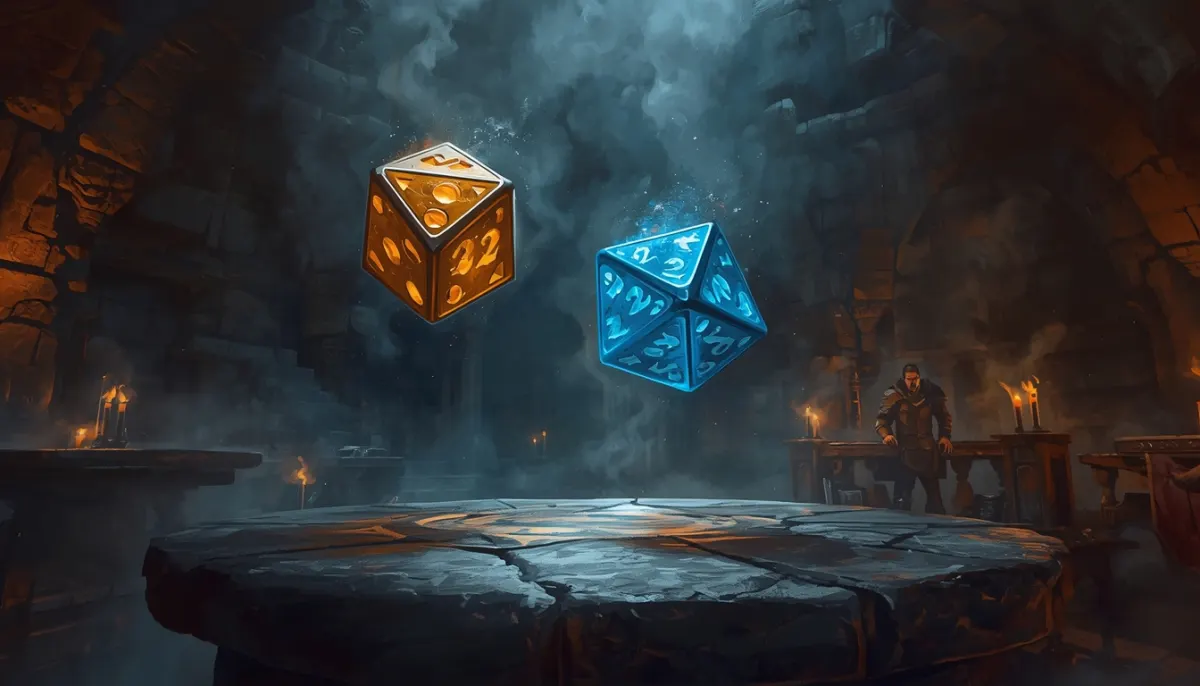
Advantage means you roll two d20s and keep the higher; Disadvantage means you keep the lower. Most modifiers in the game add or subtract a number. Advantage and Disadvantage do neither. They hand you a second d20 and tell you which of the two to keep. The rule fits on an index card, yet tables still argue about it every session: does it stack, what cancels it, which die does a reroll touch?
Every rule quoted here comes from the System Reference Document 5.2.1, the free rules the 2024 game is built on.
What the rule says
Advantage and Disadvantage apply to D20 Tests: ability checks, saving throws and attack rolls. The SRD frames them as circumstance:
Advantage reflects the positive circumstances surrounding a d20 roll, while Disadvantage reflects negative circumstances.
The mechanic is one sentence:
When a roll has either Advantage or Disadvantage, roll a second d20 when you make the roll. Use the higher of the two rolls if you have Advantage, and use the lower roll if you have Disadvantage.
The SRD's own example: roll an 18 and a 3. With Disadvantage you use the 3. With Advantage you use the 18. Then add your modifier to the die you kept, as normal.
They never stack
Three reasons to have Advantage still means two d20s, not four:
If multiple situations affect a roll and they all grant Advantage on it, you still roll only two d20s.
The same goes for Disadvantage. And when both apply, they cancel completely, whatever the count:
If circumstances cause a roll to have both Advantage and Disadvantage, the roll has neither of them, and you roll one d20. This is true even if multiple circumstances impose Disadvantage and only one grants Advantage or vice versa.
So a hero who attacks an invisible foe, while prone, with Advantage from an ally's spell rolls one d20. One source of Advantage cancels any number of sources of Disadvantage. Tables that tally up "two against one" are playing a different game.
Rerolls touch one die
Some features let you reroll a d20. With two on the table, you reroll only one:
When you have Advantage or Disadvantage and something in the game lets you reroll or replace the d20, you can reroll or replace only one die, not both. You choose which one.
Heroic Inspiration is the common case. The SRD says you "can expend it to reroll any die immediately after rolling it, and you must use the new roll." With Disadvantage and a 3 and an 18, reroll the 3: the lower of the new roll and the 18 now stands.
Where it comes from in play
The SRD says you "usually acquire Advantage or Disadvantage through the use of special abilities and actions," and that the GM "can also decide that circumstances grant Advantage or impose Disadvantage." The ones that turn up every session:
| Situation | Effect | Where in the SRD |
|---|---|---|
| Attacking a target you can't see | Disadvantage on your attack | Combat, Unseen Attackers and Targets |
| A creature that can't see you | Advantage on your attacks against it | Combat, Unseen Attackers and Targets |
| Ranged attack beyond normal range | Disadvantage | Combat, on ranged attacks |
| Ranged attack with an enemy within 5 feet who can see you | Disadvantage | Combat, Ranged Attacks in Close Combat |
| You are Prone | Disadvantage on your attacks; attacks from within 5 feet have Advantage, from further away Disadvantage | Rules Glossary, Prone |
| You are Invisible | Attacks against you have Disadvantage, yours have Advantage | Rules Glossary, Invisible |
| Barbarian's Reckless Attack | Advantage on Strength attacks, but attacks against you have Advantage too | Barbarian, Level 2 |
The Prone line is the one most often misread. Knocking a foe down helps the fighter beside it and hurts the archer across the room.
What the second die is worth
The SRD gives the rule, not the odds. The odds are plain arithmetic on two d20s.
To roll a number or higher on one d20, the chance is (21 minus the number) in 20. With Advantage you fail only if both dice fail, so square the miss chance and take it from one. With Disadvantage both dice must succeed, so square the hit chance.
| Need on the die | One d20 | Advantage | Disadvantage |
|---|---|---|---|
| 6 or more | 75% | 94% | 56% |
| 11 or more | 50% | 75% | 25% |
| 16 or more | 25% | 44% | 6% |
| 20 | 5% | 10% | 0.25% |
Two things fall out of the table.
In the middle, Advantage is worth about +5. Needing an 11, one die succeeds half the time. Advantage takes that to 75%, exactly what a flat +5 would do (needing a 6). Disadvantage drops it to 25%, the same as a flat -5.
At the edges, it is worth less, except for crits. Needing a 20, Advantage only lifts you from 5% to under 10%. But a natural 20 on an attack roll is a Critical Hit, and Advantage nearly doubles the chance of one. Disadvantage cuts it to one in four hundred.
The averages tell the same story. One d20 averages 10.5. Keep the higher of two and the average rises to 13.8; keep the lower and it falls to 7.2.
Run it fast at the table
- Keep two d20s of different colours in the bag. Roll both, every time, and say first which one counts if it matters.
- Before you roll, name the sources out loud. If there is at least one of each, roll one die and move on.
- When a reroll comes up, decide which die before you pick it up.
The Book of Dice gives this a chapter of its own in Part III, The Rolling, beside ability score methods and the notation guide.
This work includes material from the System Reference Document 5.2.1 ("SRD 5.2.1") by Wizards of the Coast LLC, available at dndbeyond.com/srd. The SRD 5.2.1 is licensed under the Creative Commons Attribution 4.0 International License.