How Mounted Combat Works in 5e
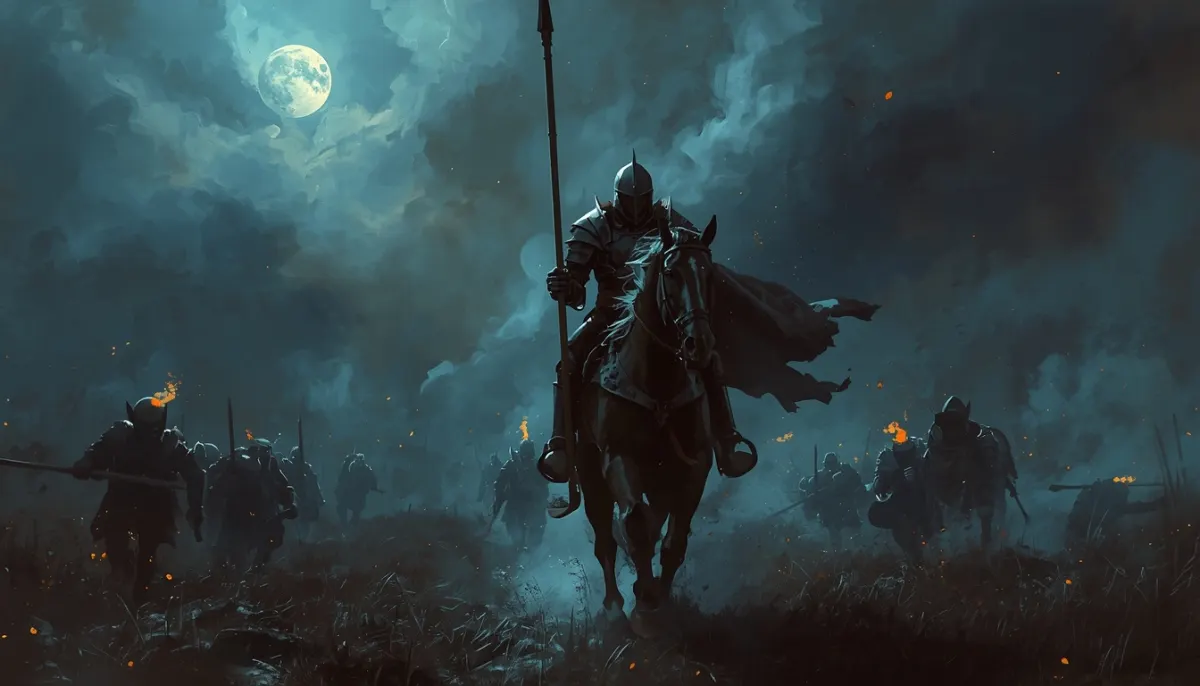
Mounting costs half your Speed, and a controlled mount moves on your turn and can only Dash, Disengage or Dodge. The Fighter buys a Warhorse for 400 GP and rides it into the next fight expecting a second set of attacks. The horse never kicks. SRD 5.2.1 gives mounted combat four short rules, and the one about control explains why. Here they are, quoted, with the numbers worked out.
What can carry you
A willing creature that is at least one size larger than a rider and that has an appropriate anatomy can serve as a mount, using the following rules.
A Medium Human or Elf rides a Large horse. A Small Halfling or Gnome can ride a Medium Pony or Mastiff. A Goblin Warrior is Small, so a Mastiff carries one too.
Getting on and off
During your move, you can mount a creature that is within 5 feet of you or dismount. Doing so costs an amount of movement equal to half your Speed (round down). For example, if your Speed is 30 feet, you spend 15 feet of movement to mount a horse.
Mounting costs movement, not your action. Walk 15 feet to the horse, spend 15 to climb on, and you still have your action.
Control: the horse gets three choices
You can control a mount only if it has been trained to accept a rider. Domesticated horses, mules, and similar creatures have such training.
The Initiative of a controlled mount changes to match yours when you mount it. It moves on your turn as you direct it, and it has only three action options during that turn: Dash, Disengage, and Dodge.
A controlled mount can move and act even on the turn that you mount it.
Attack is not on that list. The SRD Warhorse has a Hooves attack (+6, 2d4 + 4 Bludgeoning, more on a charge), and a controlled Warhorse can't use it. What the horse gives you is Speed: 60 feet a turn, 120 if it Dashes, against your 30.
The other kind of mount keeps its own turn:
In contrast, an independent mount—one that lets you ride but ignores your control—retains its place in the Initiative order and moves and acts as it likes.
An independent mount can attack. It also goes where it likes. Most mounts in a party are trained horses, so they are controlled.
Falling off
If an effect is about to move your mount against its will while you're on it, you must succeed on a DC 10 Dexterity saving throw or fall off, landing with the Prone condition (see "Rules Glossary") in an unoccupied space within 5 feet of the mount.
While mounted, you must make the same save if you're knocked Prone or the mount is.
DC 10 is low, and riders still fail it.
| Rider | Dex save | Stays on |
|---|---|---|
| Dex 10 | +0 | 55% |
| Dex 14 | +2 | 65% |
| Rogue, Dex 16, proficient | +5 | 80% |
| Dex 14 with Advantage | +2 | 87.75% |
A Military Saddle (20 GP) "gives Advantage on any ability check you make to remain mounted." The falling-off roll is a saving throw, not an ability check, and the SRD doesn't link the two. Whether the saddle helps that save is the GM's call.
When the horse goes down
Nothing in the rules makes the horse hard to reach. A Goblin Warrior's Scimitar is +4. Against a Fighter in Chain Mail with a Shield (AC 18) it hits on 14 or more: 35%. Against the Warhorse (AC 11) it hits on 7 or more: 70%. The Warhorse has 19 Hit Points; four average Scimitar hits (5 each) drop it.
A creature at 0 Hit Points has the Unconscious condition, and the SRD says what that does:
Inert. You have the Incapacitated and Prone conditions, and you drop whatever you're holding.
The mount is now Prone, so the rider makes the DC 10 save above or falls off with it.
The Lance
| Weapon | Damage | Properties | Mastery |
|---|---|---|---|
| Lance | 1d10 Piercing | Heavy, Reach, Two-Handed (unless mounted) | Topple |
From the saddle the Lance takes one hand, so the Shield stays on. Reach gives 10 feet.
Take a level 1 Fighter, Strength 16 (+3), Proficiency Bonus +2, charging a Goblin Warrior (AC 15, 10 Hit Points, Con +0):
- Hit: +5 needs 10 or more. 55%.
- Damage: 1d10 + 3, average 8.5. Ten or more needs a 7 on the d10: 40%. On a Critical Hit, 2d10 + 3 reaches 10 85% of the time.
- Goblin dropped by one thrust: 24.25%.
Fighters get Weapon Mastery at level 1, so the Lance's Topple works for them:
If you hit a creature with this weapon, you can force the creature to make a Constitution saving throw (DC 8 plus the ability modifier used to make the attack roll and your Proficiency Bonus). On a failed save, the creature has the Prone condition.
DC 8 + 3 + 2 = 13. The Goblin Warrior saves on 13 or more and fails on 1 to 12: 60%.
Then read Prone closely:
An attack roll against you has Advantage if the attacker is within 5 feet of you. Otherwise, that attack roll has Disadvantage.
A rider who stays 10 feet back with the Lance attacks the Prone goblin with Disadvantage: 55% falls to 30.25%. Ride in to 5 feet and the same thrust has Advantage: 79.75%. The friend on foot beside the goblin gets Advantage too.
What it costs
| Item | Cost | Carries |
|---|---|---|
| Mule | 8 GP | 420 lb. |
| Mastiff | 25 GP | 195 lb. |
| Pony | 30 GP | 225 lb. |
| Riding Horse | 75 GP | 480 lb. |
| Warhorse | 400 GP | 540 lb. |
A Riding Saddle costs 10 GP, a Military Saddle 20 GP. An Exotic Saddle (60 GP) "is required for riding an aquatic or a flying mount." Feed is 5 CP a day and stabling 5 SP.
At the table
- Mounting is half your Speed. Not an action.
- A controlled mount moves on your turn and only Dashes, Disengages or Dodges. No attacks.
- Pushed, knocked Prone, or the horse drops: DC 10 Dexterity save or you land Prone.
- The horse is the easy target. AC 11 against your 18.
- Lance from the saddle: one hand, 10-foot reach, and close in after a Topple.
The Book of Dice covers the d10 behind the Lance in Part I, The Object.
This work includes material from the System Reference Document 5.2.1 ("SRD 5.2.1") by Wizards of the Coast LLC, available at dndbeyond.com/srd. The SRD 5.2.1 is licensed under the Creative Commons Attribution 4.0 International License.