How the Help Action Works in 5e
The Help action gives an ally Advantage on their next ability check with a skill or tool you're proficient in, or on their next attack roll against an enemy within 5 feet of you. Help gives your action to someone else. You roll nothing. An ally rolls with Advantage instead. Most tables forget it exists, because attacking feels better. Sometimes the numbers agree with them, and sometimes they don't. Here is the rule, quoted from the SRD, and the odds.
The rule
The SRD's glossary entry:
When you take the Help action, you do one of the following.
The first option works outside combat as much as in it:
Assist an Ability Check. Choose one of your skill or tool proficiencies and one ally who is near enough for you to assist verbally or physically when they make an ability check. That ally has Advantage on the next ability check they make with the chosen skill or tool. This benefit expires if the ally doesn't use it before the start of your next turn. The GM has final say on whether your assistance is possible.
The second is for a fight:
Assist an Attack Roll. You momentarily distract an enemy within 5 feet of you, giving Advantage to the next attack roll by one of your allies against that enemy. This benefit expires at the start of your next turn.
Three details hide in those lines:
- To assist a check, you need proficiency in that skill or tool yourself. A Fighter with no Thieves' Tools can't Help the Rogue pick a lock.
- To assist an attack, you stand within 5 feet of the enemy, but the ally who gains Advantage can be anywhere, even an archer across the room.
- Both expire at the start of your next turn. The ally who benefits must act after you and before you come round again. Check the Initiative order before you spend it.
Help is an action. The SRD gives no class feature that turns it into a Bonus Action, and Cunning Action doesn't include it.
What Advantage is worth
If you have Advantage on a D20 Test, roll two d20s, and use the higher roll. A roll can't be affected by more than one Advantage, and Advantage and Disadvantage on the same roll cancel each other.
So two helpers give no more than one. And Help cancels a Disadvantage the ally already has. The gain depends on the number the ally needs:
| Needs on the d20 | Plain | With Help | Gain |
|---|---|---|---|
| 6 | 75% | 93.75% | +18.75 |
| 8 | 65% | 87.75% | +22.75 |
| 10 | 55% | 79.75% | +24.75 |
| 11 | 50% | 75% | +25 |
| 14 | 35% | 57.75% | +22.75 |
| 16 | 25% | 43.75% | +18.75 |
| 18 | 15% | 27.75% | +12.75 |
The gain peaks at 25 points when the ally needs an 11, and shrinks at both ends. Help a roll that is already easy, or nearly hopeless, and you buy little.
Cancelling Disadvantage is worth exactly the same. A Fighter with +5 against a Goblin Warrior's AC 15 hits 55% of the time, 30.25% with Disadvantage. Help lifts a Disadvantage roll back to 55%: +24.75 points, the same as lifting a plain roll to 79.75%.
Help or attack?
In combat, Help costs you your own attack. Say you are a level 1 Fighter with a Longsword, +5 to hit, 1d8 + 3 damage, against a Goblin Warrior (AC 15, 10 Hit Points). Your own swing averages 4.35 damage. Your Help is worth whatever it adds to your ally's swing:
| Ally's attack | Plain | With your Help | Gain |
|---|---|---|---|
| Fighter, Greatsword 2d6 + 3 | 5.85 | 8.66 | +2.81 |
| Wizard, Fire Bolt 1d10 | 3.30 | 4.92 | +1.62 |
| Rogue, Rapier 1d8 + 3, Sneak Attack 1d6 | 6.45 | 9.55 | +3.10 |
All three gains fall short of 4.35. Against one goblin, swing.
The Rogue row needs a closer look. Sneak Attack needs Advantage, or this:
You don't need Advantage on the attack roll if at least one of your allies is within 5 feet of the target, the ally doesn't have the Incapacitated condition, and you don't have Disadvantage on the attack roll.
To Help an attack you stand within 5 feet of the enemy, so you already switch on the Rogue's Sneak Attack just by being there. Attack, and the Rogue still gets it. Help adds only the Advantage. The sums change when your own attack is weak, when the ally hits far harder than you (higher levels, more Sneak Attack dice, a Smite waiting for a hit), or when the ally has Disadvantage you can cancel.
The helper who can't attack
Find Familiar sets the rule for familiars in combat:
A familiar can't attack, but it can take other actions as normal.
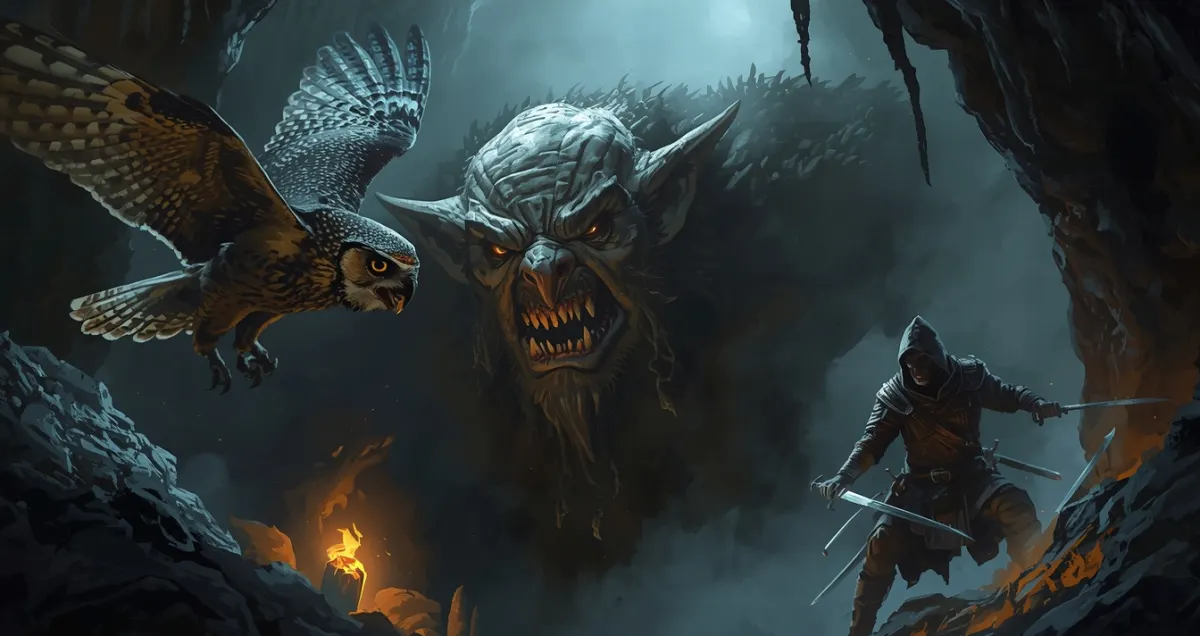
Help is another action. A familiar gives up nothing by taking it, so its Help is free. The SRD's Owl suits the job: Fly 60 ft., and this trait:
Flyby. The owl doesn't provoke an Opportunity Attack when it flies out of an enemy's reach.
The owl flies in, Helps, and flies away untouched. A Rogue with a Shortbow, +5 to hit, 1d6 + 3, shooting a Goblin Warrior with no ally beside it, averages 3.75 damage a turn. With the owl beside the goblin, the shot has Advantage and Sneak Attack: 8.66. The owl has 1 Hit Point and AC 11, so it gets hit sometimes. When a familiar drops to 0 Hit Points it disappears until you cast the spell again: another hour of casting and 10 GP of incense.
Help outside combat
Out of combat, assisting a check is the everyday use. A Rogue with Thieves' Tools at +5 against a DC 15 lock opens it 55% of the time. A second proficient character Helping makes it 79.75%. Against DC 20: 30% becomes 51%.
The SRD also limits stacking actions:
When you're exploring a dungeon, you can't simultaneously use the Search action to look for traps and use the Help action to aid another character who's trying to open a stuck door.
One action, one job. If the party needs both, two characters do them.
Help the dying
Help has a third use, from the Death Saving Throws rules:
You can take the Help action to try to stabilize a creature with 0 Hit Points, which requires a successful DC 10 Wisdom (Medicine) check.
Wisdom +0 with no proficiency succeeds 55% of the time. A Cleric with Wisdom +3 and Medicine succeeds 80%. A Healer's Kit removes the roll:
As a Utilize action, you can expend one of its uses to stabilize an Unconscious creature that has 0 Hit Points without needing to make a Wisdom (Medicine) check.
A Stable creature stays Unconscious, so stabilizing stops the dying but doesn't bring the ally back into the fight. The death saving throws post has the odds of leaving them alone.
Using it at the table
- Help when the ally needs a 9 to 13. That is where Advantage adds the most.
- Help to cancel a Disadvantage: Prone, Poisoned, a long-range shot.
- Give the familiar something to do every round. Help is its best action.
- Check the Initiative order. Help that expires before the ally acts is a wasted turn.
The Book of Dice covers the odds of two d20s, highest kept, in Part III, The Rolling.
This work includes material from the System Reference Document 5.2.1 ("SRD 5.2.1") by Wizards of the Coast LLC, available at dndbeyond.com/srd. The SRD 5.2.1 is licensed under the Creative Commons Attribution 4.0 International License.