How Death Saving Throws Work in 5e
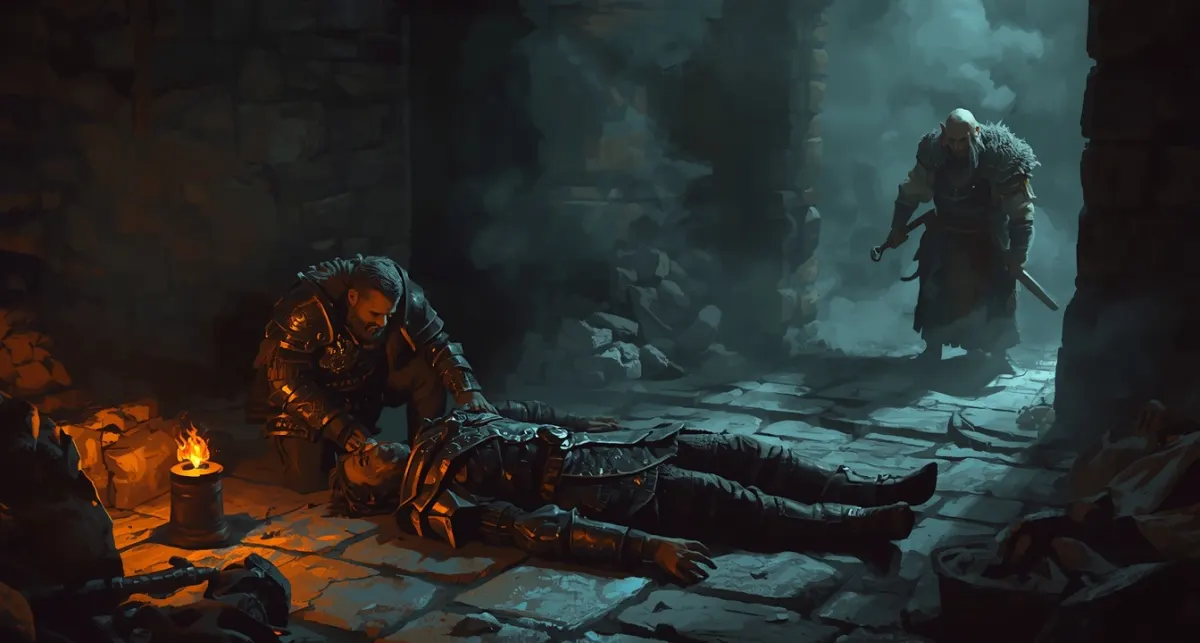
At 0 Hit Points you roll a d20 at the start of each turn: 10 or higher is a success, three successes make you Stable, and three failures kill you. The ogre's club lands and the Fighter's Hit Points hit 0. The player looks up and asks, "Am I dead?" Usually not yet. SRD 5.2.1 gives 0 Hit Points its own short set of rules, and every one of them changes what the rest of the table should do next. Here they are, quoted, with the odds worked out.
Dropping to 0
When a creature drops to 0 Hit Points, it either dies outright or falls unconscious, as explained below.
Three things kill outright. The first is why goblins never make Death Saves:
Monster Death. A monster dies the instant it drops to 0 Hit Points, although a Game Master can ignore this rule for an individual monster and treat it like a character.
Hit Point Maximum of 0. A creature dies if its Hit Point maximum reaches 0. Certain effects drain life energy, reducing a creature's Hit Point maximum.
Massive Damage. When damage reduces a character to 0 Hit Points and damage remains, the character dies if the remainder equals or exceeds their Hit Point maximum.
The SRD's own example: a character with a maximum of 12, on 6 Hit Points, takes 18 damage. Six damage takes them to 0, 12 remains, and 12 equals their maximum. They die. At level 1 this is a real risk. A Wizard with 7 Hit Points, on 3, dies to any hit of 10 or more.
Falling Unconscious
If you reach 0 Hit Points and don't die instantly, you have the Unconscious condition (see "Rules Glossary") until you regain any Hit Points, and you now face making Death Saving Throws (see below).
Unconscious is a heavy condition. The parts that matter here:
Attack rolls against you have Advantage.
Any attack roll that hits you is a Critical Hit if the attacker is within 5 feet of you.
Hold onto those two. They come back below.
The Death Saving Throw
Whenever you start your turn with 0 Hit Points, you must make a Death Saving Throw to determine whether you creep closer to death or hang on to life. Unlike other saving throws, this one isn't tied to an ability score. You're in the hands of fate now.
Three Successes/Failures. Roll 1d20. If the roll is 10 or higher, you succeed. Otherwise, you fail. A success or failure has no effect by itself. On your third success, you become Stable (see "Stabilizing a Character" below). On your third failure, you die.
The successes and failures don't need to be consecutive; keep track of both until you collect three of a kind. The number of both is reset to zero when you regain any Hit Points or become Stable.
Rolling a 1 or 20. When you roll a 1 on the d20 for a Death Saving Throw, you suffer two failures. If you roll a 20 on the d20, you regain 1 Hit Point.
So each roll is:
| d20 | Result | Chance |
|---|---|---|
| 1 | Two failures | 5% |
| 2–9 | One failure | 40% |
| 10–19 | One success | 50% |
| 20 | Regain 1 Hit Point, wake up | 5% |
No modifier, no proficiency. A level 1 Wizard and a level 20 Paladin roll the same die.
The odds, left alone
If nobody helps and nothing hits you, the rolls play out like this:
| Outcome | Chance |
|---|---|
| Stable (three successes) | 41.4% |
| Wake up on a 20 | 18.1% |
| Die (three failures) | 40.5% |
Roughly a coin flip between living and dying. How fast it goes matters just as much:
| After your... | Already dead | Still rolling |
|---|---|---|
| 1st Death Save | 0% | 95% |
| 2nd | 4.25% | 86% |
| 3rd | 15.7% | 57.75% |
| 4th | 29.7% | 24% |
| 5th | 40.5% | 0% |
You can't die on your first roll, even on a 1. That gives the party one full round for free. After the second roll, every turn counts.
One failure changes things. With one failure already marked, your chance of dying is 58.25%. With two, it is 78.75%. With two successes and no failures, it is 11.45%.
Damage while you're down
Damage at 0 Hit Points. If you take any damage while you have 0 Hit Points, you suffer a Death Saving Throw failure. If the damage is from a Critical Hit, you suffer two failures instead. If the damage equals or exceeds your Hit Point maximum, you die.
Put that beside Unconscious. Any melee hit from within 5 feet is a Critical Hit, so any melee hit is two failures. And a Critical Hit doubles the damage dice.
A Goblin Warrior's Scimitar is "+4, reach 5 ft. Hit: 5 (1d6 + 2) Slashing damage, plus 2 (1d4) Slashing damage if the attack roll had Advantage." Against an Unconscious target it always has Advantage, and every hit crits: 2d6 + 2d4 + 2, average 14.
- Level 1 Wizard, 7 Hit Point maximum, AC 12. The goblin hits 87.75% of the time. On a hit, the damage is 7 or more 99.8% of the time, which equals the Wizard's maximum. One swing, 87.6% dead.
- Level 3 Fighter, 28 Hit Point maximum, AC 16. The goblin hits 69.75% of the time. 22 is the most it can do, so no instant death, but every hit is two failures. Two goblins on one turn: both hit 48.7% of the time, and that is four failures. Dead.
Whether a monster attacks a downed hero is the DM's call. When it does, a downed character is in a lot more danger than the Death Save odds show.
Stabilizing
You can take the Help action to try to stabilize a creature with 0 Hit Points, which requires a successful DC 10 Wisdom (Medicine) check.
A Stable creature doesn't make Death Saving Throws even though it has 0 Hit Points, but it still has the Unconscious condition. If the creature takes damage, it stops being Stable and starts making Death Saving Throws again. A Stable creature that isn't healed regains 1 Hit Point after 1d4 hours.
DC 10 Medicine: with +0 it works 55% of the time; +2, 65%; +5, 80%. Two ways never miss:
A Healer's Kit has ten uses. As a Utilize action, you can expend one of its uses to stabilize an Unconscious creature that has 0 Hit Points without needing to make a Wisdom (Medicine) check.
Spare the Dying. Choose a creature within range that has 0 Hit Points and isn't dead. The creature becomes Stable.
Spare the Dying is a Cleric and Druid cantrip with a 15-foot range. A Healer's Kit costs 5 GP. Every party should own one.
Healing is better
Stable means unconscious for hours. Any healing at all ends the Unconscious condition and resets both counts to zero. Healing starts from 0, so even 1 Hit Point is enough to stand back up.
| Source | Cost to use | Heals |
|---|---|---|
| Potion of Healing (50 GP) | Bonus Action, drink or give to someone within 5 feet | 2d4 + 2, average 7 |
| Healing Word, level 1 | Bonus Action, 60 feet, Verbal only | 2d4 + modifier, average 8 with +3 |
| Cure Wounds, level 1 | Action, touch | 2d8 + modifier, average 12 with +3 |
Healing Word is the usual answer. It costs a Bonus Action, so the Cleric still gets their Action, and 60 feet means they don't have to walk into the goblins to reach their friend.
Temporary Hit Points don't count:
If you have 0 Hit Points, receiving Temporary Hit Points doesn't restore you to consciousness. Only true healing can save you.
At the table
- Mark both counts. Successes and failures don't reset each other. Only healing or becoming Stable clears them.
- The first round is free. You can't die on your first Death Save unless something hits you. Use that round, don't panic it away.
- Get the downed hero out of reach. A goblin standing next to them turns every hit into two failures. Kill it, shove it away, or stand in the way.
- Bring a Healer's Kit. Ten guaranteed stabilizations for 5 GP.
- Heal at range. Healing Word from 60 feet saves a life and keeps the Cleric out of the fight.
- Roll in the open. A Death Save at the table, in front of everyone, is one of the best moments in the game. Let it be.
The Book of Dice covers the d20 in Part I, The Object, and why a single roll with no modifier feels the way it does in Part III, The Rolling.
This work includes material from the System Reference Document 5.2.1 ("SRD 5.2.1") by Wizards of the Coast LLC, available at dndbeyond.com/srd. The SRD 5.2.1 is licensed under the Creative Commons Attribution 4.0 International License.