How Reckless Attack Works in 5e
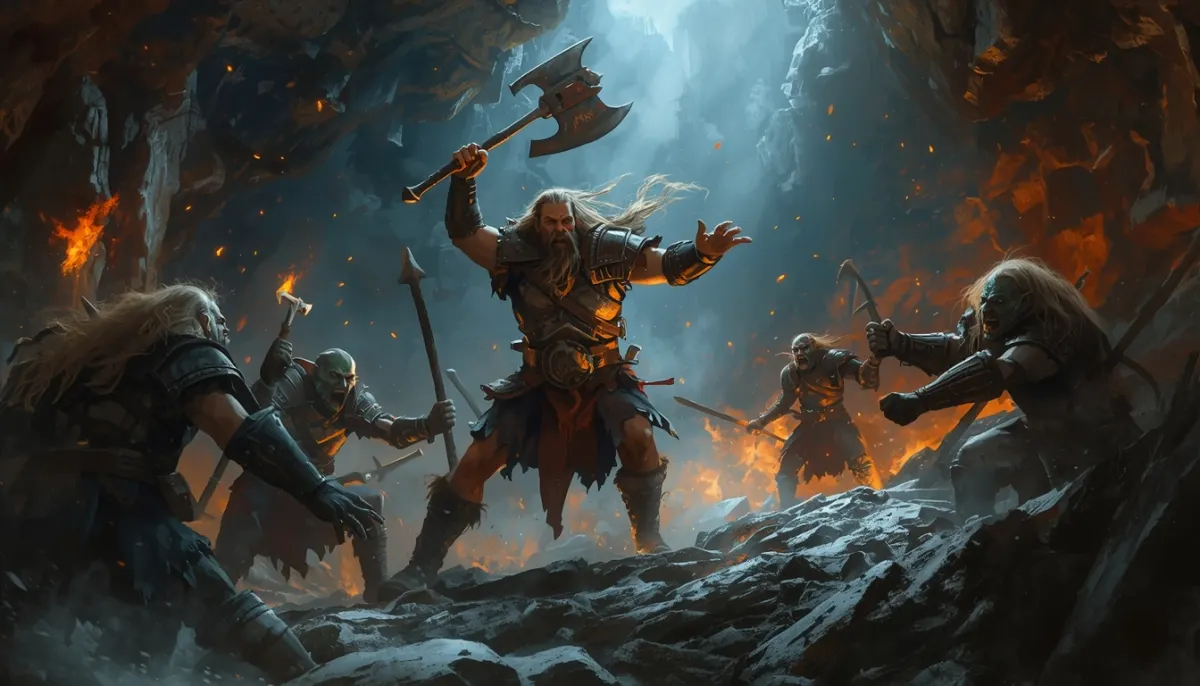
Reckless Attack is the Barbarian's level 2 feature. When you make your first attack roll on your turn, you can choose to attack recklessly: you get Advantage on attack rolls using Strength until the start of your next turn, and attack rolls against you have Advantage for the same time. It costs no action and no use. A level 2 Barbarian swinging at a Goblin Warrior goes from a 55% hit chance to 79.75%; the goblin's chance to hit back rises by the same amount. Below: the rule quoted, the three details people miss, and the trade worked out against goblins, an Ogre and an Owlbear.
The rule
When you make your first attack roll on your turn, you can decide to attack recklessly. Doing so gives you Advantage on attack rolls using Strength until the start of your next turn, but attack rolls against you have Advantage during that time.
Three details catch people.
- You decide on the first attack roll. Not after seeing it. If you skip Reckless Attack on your first swing, you can't turn it on for the second.
- Strength only. A Dexterity attack with a Rapier or a Shortbow gets nothing. A thrown Handaxe or Javelin uses Strength, so it does. So does a punch: an Unarmed Strike's damage option is a Strength attack roll (Grapple and Shove are saves, so Advantage does nothing there).
- Every attacker, every turn. The Advantage against you lasts through every enemy's turn until yours comes round, and covers ranged attacks and spell attacks too, not only the creature you hit.
Advantage from Reckless Attack cancels against any Disadvantage on the same roll, the same as any other source. Advantage and Disadvantage covers the cancel rule. A Prone Barbarian who attacks recklessly rolls one d20: the Advantage cancels the Prone Disadvantage.
Against goblins
A level 2 Barbarian with Strength 16 and Constitution 14 has AC 14, 23 Hit Points and a Greataxe at +5 for 1d12 + 3, plus 2 while raging. The SRD Goblin Warrior has AC 15 and 10 Hit Points, and its Scimitar hits at +4 for 1d6 + 2, plus 1d4 more if the roll had Advantage.
| Normal | Reckless | |
|---|---|---|
| Your hit chance | 55% | 79.75% |
| One swing kills | 38.1% | 56.0% |
| Goblin hit chance | 55% | 79.75% |
| Damage per goblin, raging | 1.46 | 3.28 |
The goblin's Scimitar gets better twice: it hits more often and adds the 1d4. Against three goblins, a raging Barbarian takes about 4.4 damage a round normally and 9.8 attacking recklessly. The extra kill chance is worth that only if the goblin you hit is the one that would have hit you; with three of them around you, it is a bad trade at 23 Hit Points.
Against an Ogre
The Ogre has AC 11, 68 Hit Points and a Greatclub at +6 for 2d8 + 4.
| Normal | Reckless | |
|---|---|---|
| Your damage per turn | 8.95 | 11.41 |
| Ogre damage per turn, raging | 4.29 | 5.92 |
| Ogre damage per turn, no Rage | 8.90 | 12.29 |
Against AC 11 you already hit 75% of the time, so Advantage adds less: 2.46 damage for 1.63 taken while raging. Without Rage, Reckless Attack costs you 3.39 a turn for the same 2.46. That is the pattern: Reckless Attack is a Rage feature in practice. Resistance halves what the Advantage gives away. How Rage Works covers the halving.
At level 3, the Path of the Berserker adds Frenzy:
If you use Reckless Attack while your Rage is active, you deal extra damage to the first target you hit on your turn with a Strength-based attack. To determine the extra damage, roll a number of d6s equal to your Rage Damage bonus, and add them together.
That is 2d6 on the first hit at Rage Damage +2. Against the Ogre, a raging, reckless Berserker averages 18.66 a turn with one Greataxe swing, against 11.41 without Frenzy.
At level 5, against an Owlbear
Extra Attack doubles what Advantage is worth, because both swings get it. A level 5 Barbarian with Strength 18 and Constitution 16 has AC 15 and attacks twice at +7 for 1d12 + 4, plus 2 raging. The SRD Owlbear has AC 13 and makes two Rend attacks at +7 for 2d8 + 5.
| Normal | Reckless | |
|---|---|---|
| Your damage per turn | 19.40 | 24.70 |
| Owlbear damage per turn, raging | 9.22 | 12.72 |
Reckless Attack adds 5.30 damage for 3.50 taken. The Owlbear's 59 Hit Points go in about 2.4 turns instead of 3, so the Barbarian takes fewer turns of Owlbear in total. Extra Attack covers the two swings.
Brutal Strike, level 9
If you use Reckless Attack, you can forgo any Advantage on one Strength-based attack roll of your choice on your turn. The chosen attack roll mustn't have Disadvantage. If the chosen attack roll hits, the target takes an extra 1d10 damage of the same type dealt by the weapon or Unarmed Strike, and you can cause one Brutal Strike effect of your choice.
The two effects at level 9:
- Forceful Blow. Pushes the target 15 feet straight away; you can follow up to half your Speed without provoking Opportunity Attacks.
- Hamstring Blow. Cuts the target's Speed by 15 feet until the start of your next turn.
You still pay the cost: attackers have Advantage against you whether or not you keep it. At level 9 with Strength 20 (+9 to hit, 1d12 + 8 raging), one swing with Advantage against one Brutal Strike:
| Target AC | Advantage swing | Brutal Strike swing |
|---|---|---|
| 13 | 14.81 | 17.60 |
| 15 | 14.23 | 15.60 |
| 17 | 13.36 | 13.60 |
| 19 | 12.20 | 11.60 |
Against AC 17 or lower, Brutal Strike deals more even before its push or slow. Against AC 19, keeping Advantage wins on damage; take Brutal Strike there only for the effect. Level 13 adds Staggering Blow and Sundering Blow; level 17 raises the extra damage to 2d10 and lets you pick two effects.
When to use it
- Raging, one big target: yes. Resistance makes the trade cheap.
- Not raging: rarely. You give away more than you gain.
- Surrounded by many weak attackers: no, unless one swing ends the fight.
- Low on Hit Points: no. Advantage against you nearly doubles each attacker's Critical Hit chance, from 5% to 9.75%.
- Berserker, or level 9 or higher: almost always while raging, because Frenzy and Brutal Strike both need it.
Every number here comes from the d20 rolled twice and the d12 behind it. The Book of Dice covers both in Part I, The Object. The odds here are computed exactly from the dice above.
This work includes material from the System Reference Document 5.2.1 ("SRD 5.2.1") by Wizards of the Coast LLC, available at dndbeyond.com/srd. The SRD 5.2.1 is licensed under the Creative Commons Attribution 4.0 International License.