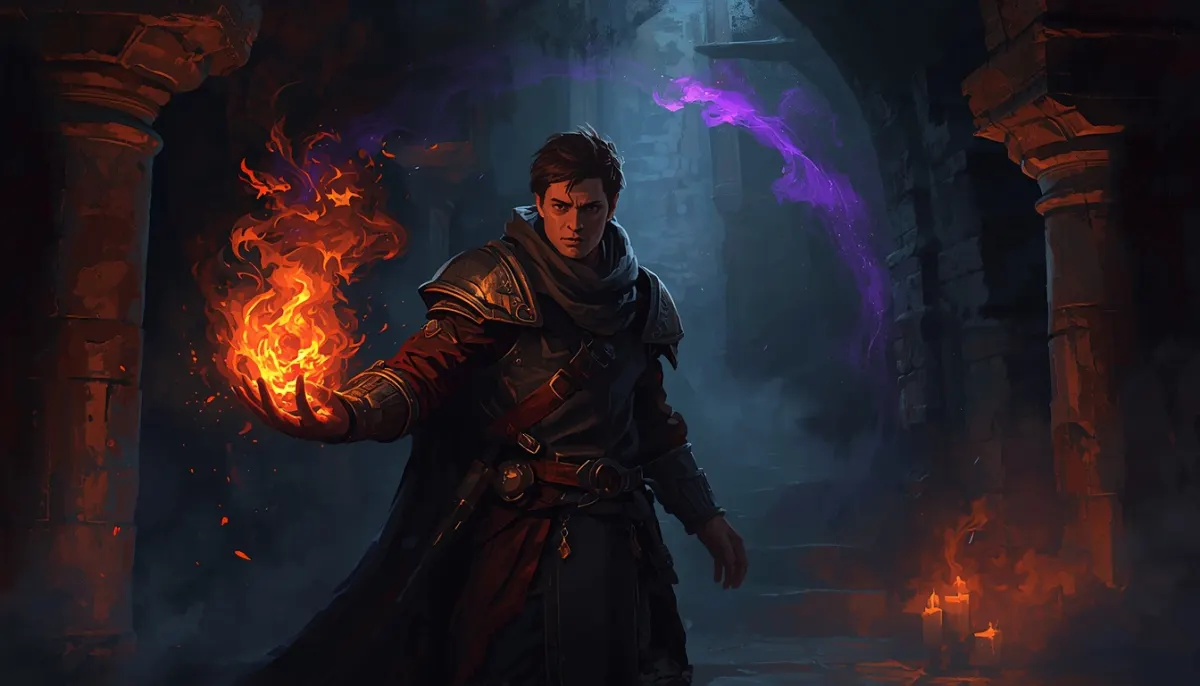
How Does Fear Work in D&D 5e?
Fear in 5e is a Wisdom saving throw against a DC set by how terrifying the threat is (the SRD's samples are 10, 15 and 20); fail it and you have the Frightened condition. A sword hurts your Hit Points. Fear hurts your turn. The SRD gives Game Masters a short toolbox for scaring heroes and fraying their minds, and it opens with a warning to the table, not the dice. Here is all of it, quoted, with the odds worked out for three heroes: a Rogue (Wisdom save +0), a Wizard (+3, proficient) and a Cleric (+5, proficient).
Ask first
The section starts with a line most rules skip:
If you plan to use any of these rules, discuss them with your players at the start of the campaign.
That matters. These rules take control away from a player's character. A table that agreed to them in session one plays them as horror. A table that didn't feels cheated.
The SRD also sets the baseline. Adventurers "tend to be less susceptible to fear and mental stress than common folk. Whereas a farmer might flee in terror from a bear or an apparition, adventurers are made of sterner stuff." A goblin ambush is not a fear effect. Save these rules for the supernatural.
Fear uses the Frightened condition
Whenever the characters encounter something that is supernaturally frightful, use the Frightened condition as the baseline effect. Fear effects typically require a Wisdom saving throw, with a save DC based on how terrifying the situation is.
The condition itself, from the rules glossary:
Ability Checks and Attacks Affected. You have Disadvantage on ability checks and attack rolls while the source of fear is within line of sight. Can't Approach. You can't willingly move closer to the source of fear.
Disadvantage is a big number. A hero who needs an 11 to hit lands it 50% of the time on one d20. Frightened, rolling two and keeping the lower, that drops to 25%: half the damage output, gone.
The sample fear DCs
| Example | Save DC |
|---|---|
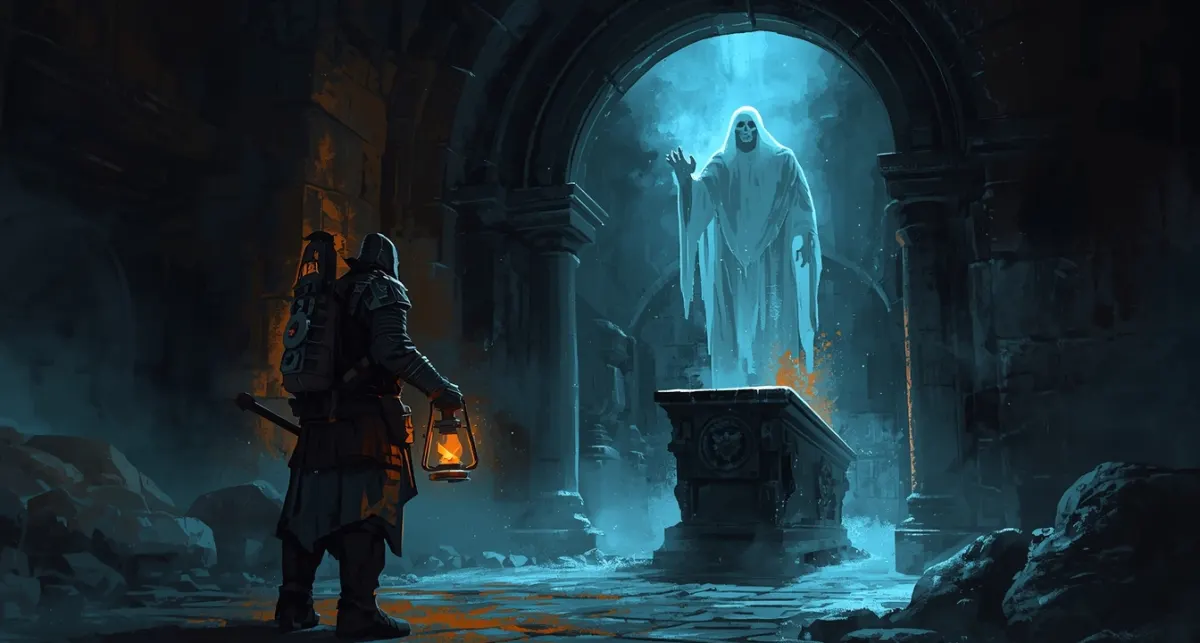
| A harmless yet terrifying apparition rises from an opened sarcophagus | 10 |
| A magical trap shows one character their worst fears, visible only to them | 15 |
| A portal to the Abyss opens on a nightmarish realm of torment and slaughter | 20 |
Here is how often each hero fails the first save:
| Wisdom save | DC 10 | DC 15 | DC 20 |
|---|---|---|---|
| Rogue +0 | 45% | 70% | 95% |
| Wizard +3 | 30% | 55% | 80% |
| Cleric +5 | 20% | 45% | 70% |
Even the Cleric fails the Abyss save 7 times in 10. The DC 20 column is meant to land.
Getting out of it
Typically, a Frightened creature repeats the saving throw at the end of each of its turns, ending the effect on itself on a success.
So fear lasts a number of turns, and the turns come one after another until a save lands. Once Frightened, the average number of turns a hero spends afraid:
| Wisdom save | DC 10 | DC 15 | DC 20 |
|---|---|---|---|
| Rogue +0 | 1.8 | 3.3 | 20 |
| Wizard +3 | 1.4 | 2.2 | 5 |
| Cleric +5 | 1.3 | 1.8 | 3.3 |
The DC 15 trap shows the spread. The Rogue fails the first save 70% of the time and is still afraid after three more turns 34% of the time. The Cleric fails 45% of the time and stays afraid that long only 9% of the time. Proficiency in Wisdom saves is the difference between a bad round and a lost fight.
The optional extras
The GM may add more while the condition lasts. The SRD's examples:
- "The Frightened creature must take the Dash action on each of its turns and uses its movement to get farther away from the source of its fear."
- "Attack rolls against the Frightened creature have Advantage."
- "The Frightened creature can do only one of the following on each of its turns: move, take an action, or take a Bonus Action."
Each one is a heavy cost. The first takes the whole turn. The second turns a monster's 50% hit into a 75% hit. Pick one per scene, and tell the player which one before they roll.
Mental stress is Psychic damage
Fear stops you acting. Mental stress hurts.
When a character is subjected to an effect that causes intense mental stress, Psychic damage is the best way to emulate that effect.
Mental stress can usually be resisted with a successful Wisdom save, but sometimes an Intelligence or Charisma save is more appropriate. On a successful save, a character might take half as much damage instead of no damage, at your discretion.
| Example | Save DC | Psychic damage | Average |
|---|---|---|---|
| A hallucinogenic substance distorts the character's perception | 10 | 1d6 | 3.5 |
| A fiendish idol tears at the character's mind | 15 | 3d6 | 10.5 |
| A magical trap flings the character into the Far Realm until the end of their next turn | 20 | 9d6 | 31.5 |
The Far Realm trap is a killer at mid levels. A level 5 Wizard with Constitution +1 has 27 Hit Points; 9d6 rolls 27 or more 83% of the time. A level 5 Fighter with Constitution +2 has 44 Hit Points; 9d6 reaches that 0.9% of the time. Same trap, very different night. Halving on a success, the GM's call, saves the Wizard.
Effects that outlast the scene
Exposure to mental stress can cause prolonged effects.
The SRD gives three lengths:
- Short-term. The character "has the Frightened, Incapacitated, or Stunned condition for 1d10 minutes." That averages 5.5 minutes, about 55 combat rounds: the whole next fight.
- Long-term. The character "has Disadvantage on some or all ability checks for 1d10 × 10 hours." That averages 55 hours, more than two days. The SRD's examples: a hero "unable to exert much Strength," or "so suspicious of others that Charisma checks are more difficult."
- Indefinite. "A long-term effect (see above) that lasts until removed by a Greater Restoration spell."
The cures
The toolbox names three spells:
- Calm Emotions (level 2, Bard and Cleric) suppresses all three kinds. In the spell's own words, a target gets "Immunity to the Charmed and Frightened conditions until the spell ends," and existing ones "are suppressed for the duration." It needs Concentration, up to 1 minute, and it reaches only Humanoids: "Each Humanoid in a 20-foot-radius Sphere" makes a Charisma save.
- Lesser Restoration (level 2, a Bonus Action) removes short-term and long-term effects, per the toolbox. Read its own list, though: it ends "Blinded, Deafened, Paralyzed, or Poisoned." Frightened from a plain fear effect is not on it.
- Greater Restoration (level 5, diamond dust worth 100+ GP, consumed) is the only cure the SRD names for indefinite effects.
One spell guards against fear before it starts. Heroism (level 1, Bard and Paladin): "Until the spell ends, the creature is immune to the Frightened condition and gains Temporary Hit Points equal to your spellcasting ability modifier at the start of each of its turns." Cast it before the sarcophagus opens.
At the table
- Agree to these rules in session one.
- Fear is the Frightened condition and a Wisdom save. Pick the DC from the table: 10, 15 or 20.
- Repeat the save at the end of each turn. The Rogue fails a DC 15 save 70% of the time; the Cleric 45%.
- Mental stress is Psychic damage. The 9d6 Far Realm trap drops a level 5 Wizard 83% of the time.
- Heroism before, Calm Emotions during, Greater Restoration for what lingers.
The Book of Dice covers the d20, Disadvantage and why a DC 15 feels so much harder than 13 in Part III, The Rolling.
This work includes material from the System Reference Document 5.2.1 ("SRD 5.2.1") by Wizards of the Coast LLC, available at dndbeyond.com/srd. The SRD 5.2.1 is licensed under the Creative Commons Attribution 4.0 International License.