How Saving Throws Work in D&D 5e
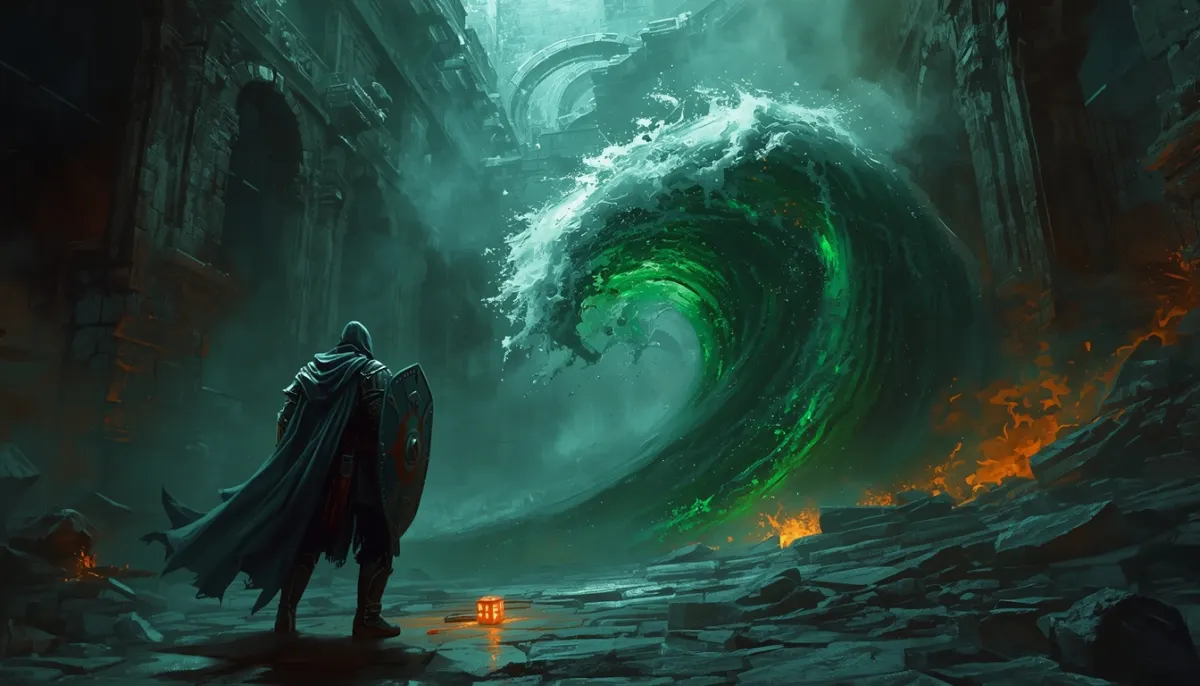
A saving throw is a d20 plus the ability modifier, plus your Proficiency Bonus if you are proficient, rolled against the effect's Difficulty Class. An attack roll is something you do. A saving throw is something done to you. The fireball is already on its way; the only question left is how much of it you take.
What a save is
SRD 5.2.1 puts it plainly:
A saving throw—also called a save—represents an attempt to evade or resist a threat, such as a fiery explosion, a blast of poisonous gas, or a spell trying to invade your mind. You don't normally choose to make a save; you must make one because your character or a monster (if you're the GM) is at risk.
The roll works like any other d20 test: roll a d20, add the ability modifier, add your Proficiency Bonus if you have proficiency in that save, and compare the total to a Difficulty Class. Meet or beat it and you succeed. What success buys you depends on the effect: "A save's result is detailed in the effect that caused it." Often it means half damage instead of full, or shrugging off a condition entirely.
One line most tables forget: "If you don't want to resist the effect, you can choose to fail the save without rolling." A friendly cleric's spell that calls for a save, for instance.
Six saves, six kinds of danger
Each save takes its name from the ability it uses. The SRD's own examples:
| Ability | Make a save to |
|---|---|
| Strength | Physically resist direct force |
| Dexterity | Dodge out of harm's way |
| Constitution | Endure a toxic hazard |
| Intelligence | Recognize an illusion as fake |
| Wisdom | Resist a mental assault |
| Charisma | Assert your identity |
In play, three of them come up far more than the rest. Dexterity saves meet anything that explodes or falls. Constitution saves meet poison, disease and the effort of holding a spell together. Wisdom saves meet charm, fear and mind control. The other three turn up less often, and they hurt more when they do, because few characters train them.
Who sets the DC
The rules say: "The Difficulty Class for a saving throw is determined by the effect that causes it or by the GM." For spells, the caster's numbers decide it:
Spell save DC = 8 + your spellcasting ability modifier + your Proficiency Bonus
A new wizard with Intelligence 16 (+3) and a Proficiency Bonus of +2 sets a DC of 13. Monsters carry their DC in the stat block, written into the action that calls for the save. Our post on reading a stat block shows where to find it.
For an effect that is not a spell or a monster, such as a collapsing floor, the GM picks a number. The SRD's Typical Difficulty Classes table gives the scale: Easy 10, Medium 15, Hard 20, Very hard 25.
Your class trains two saves
Each class gives proficiency in at least two saving throws, representing that class's training in evading or resisting certain threats.
Each class's Core Traits table in SRD 5.2.1 names the pair:
| Class | Saving throw proficiencies |
|---|---|
| Barbarian, Fighter | Strength and Constitution |
| Monk, Ranger | Strength and Dexterity |
| Bard | Dexterity and Charisma |
| Rogue | Dexterity and Intelligence |
| Sorcerer | Constitution and Charisma |
| Cleric, Paladin, Warlock | Wisdom and Charisma |
| Druid, Wizard | Intelligence and Wisdom |
Every class gets one save from the common three (Strength, Dexterity, Constitution) and one from the mental three (Intelligence, Wisdom, Charisma). Nobody trains everything, so every party has a gap. A table of Fighters and Barbarians is in trouble the night a monster casts a charm spell.
Proficiency adds your Proficiency Bonus, which the Character Advancement table sets at +2 from level 1 to 4 and raises from there. Against a DC 13 spell, a character with a +0 modifier and no proficiency needs 13 or higher on the d20: 8 faces in 20, a 40% chance. Add proficiency and it drops to 11 or higher: 50%. A trained save turns a likely failure into a coin toss, and it grows with every few levels.
The save that uses no ability
At 0 Hit Points the rules change:
Whenever you start your turn with 0 Hit Points, you must make a Death Saving Throw to determine whether you creep closer to death or hang on to life. Unlike other saving throws, this one isn't tied to an ability score. You're in the hands of fate now.
Roll 1d20. On 10 or higher you succeed; below that you fail. Three successes and you become Stable. Three failures and you die. They don't need to come in a row. Two special faces change the count: "When you roll a 1 on the d20 for a Death Saving Throw, you suffer two failures. If you roll a 20 on the d20, you regain 1 Hit Point."
So what are the odds, if nobody helps? We worked them out exactly, through every possible run of rolls with the 1 and the 20 included: a character left alone on the floor lives 59.5% of the time and dies 40.5% of the time. That is two chances in five of losing the character with nobody else rolling a single die. Add an enemy's hit while you lie there, which the SRD counts as one more failure (two on a Critical Hit), and the odds turn quickly.
The lesson for the table: any healing, or a Medicine check, on a fallen friend is rarely a wasted turn.
On the sheet
Our character builder lists a saving throw under each ability. A filled dot marks the two your class trains, and the bonus already includes your Proficiency Bonus. Tap the number to roll it. Death Saving Throws have their own boxes on the Combat tab: three for successes, three for failures, and a button to roll.
The Book of Dice covers the d20 in Part I, The Object, and every way of rolling it in Part III.
This work includes material from the System Reference Document 5.2.1 ("SRD 5.2.1") by Wizards of the Coast LLC, available at dndbeyond.com/srd. The SRD 5.2.1 is licensed under the Creative Commons Attribution 4.0 International License.