D&D 5e Conditions Explained
Hit points tell you how close you are to dropping. Conditions tell you what you can still do on the way down. A Restrained fighter at full health is in more trouble than a free one at half, and a table that knows the fifteen conditions runs a fight in half the time.
What a condition is
SRD 5.2.1 gives the whole idea in two sentences:
A condition is a temporary game state. The definition of a condition says how it affects its recipient, and various rules define how to end a condition.
So a condition never says how it starts. A spell, a monster's attack or a fall hands it to you, and the thing that gave it usually says how it ends. The condition itself only says what changes while you have it.
The fifteen: Blinded, Charmed, Deafened, Exhaustion, Frightened, Grappled, Incapacitated, Invisible, Paralyzed, Petrified, Poisoned, Prone, Restrained, Stunned and Unconscious.
One rule covers all of them:
A condition doesn't stack with itself; a recipient either has a condition or doesn't. The Exhaustion condition is an exception to that rule.
Two goblins poisoning you is still just Poisoned. Only Exhaustion counts up.
The eight you see every session
Prone. You fell, or something knocked you down. You crawl, or spend half your Speed to stand. Then the part everyone forgets:
You have Disadvantage on attack rolls. An attack roll against you has Advantage if the attacker is within 5 feet of you. Otherwise, that attack roll has Disadvantage.
Lying flat is bad next to the orc and good against the archer across the room. Dropping prone behind the goblin's arrows is a real tactic.
Grappled. Your Speed is 0 and can't increase. You have Disadvantage on attacks against anyone except the grappler, and the grappler can drag you along. To get out:
A Grappled creature can use its action to make a Strength (Athletics) or Dexterity (Acrobatics) check against the grapple's escape DC, ending the condition on itself on a success.
You pick the skill. The rogue with high Dexterity slips out; the barbarian shoves.
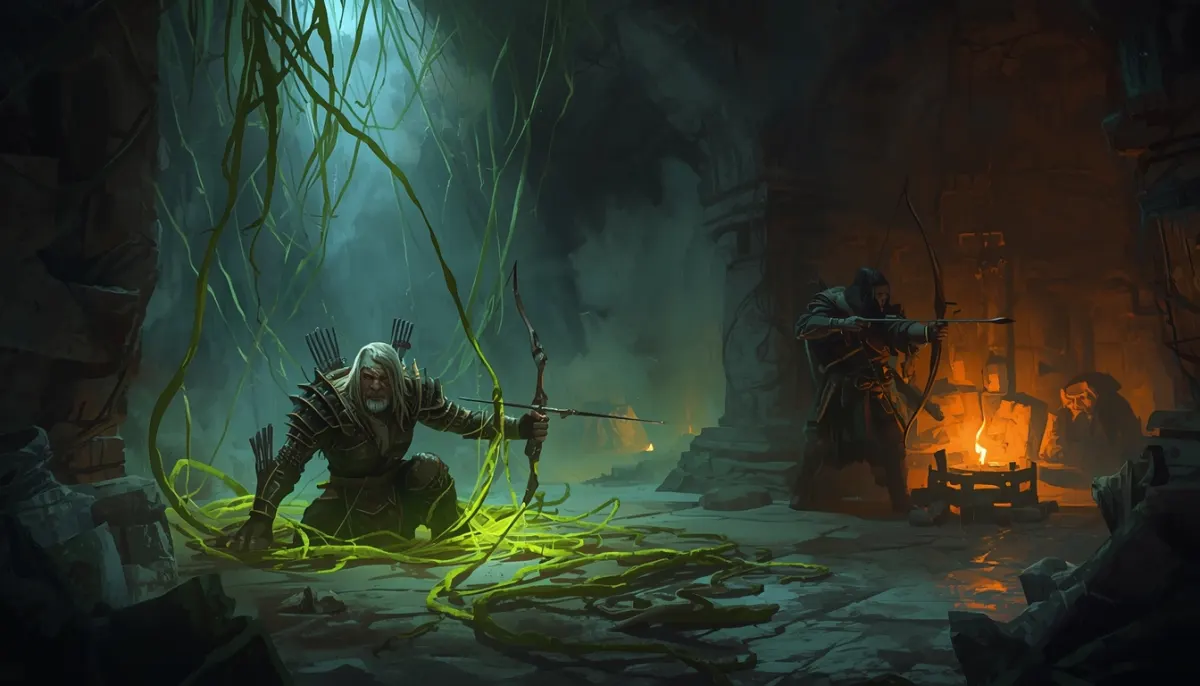
Restrained. Grappled's nastier cousin, from nets, webs and vines. Speed 0, and:
Attack rolls against you have Advantage, and your attack rolls have Disadvantage.
It also gives you Disadvantage on Dexterity saving throws, which is exactly the save a fireball asks for.
Poisoned. One line: Disadvantage on attack rolls and ability checks. Saves are untouched.
Frightened. Disadvantage on ability checks and attack rolls "while the source of fear is within line of sight", and you "can't willingly move closer to the source of fear". Break line of sight, around a corner or behind a wall, and the Disadvantage goes away, though the condition stays.
Blinded. You automatically fail any check that needs sight. Attacks against you have Advantage; yours have Disadvantage.
Incapacitated. No action, no Bonus Action, no Reaction, and your Concentration breaks. You can't speak. If you roll Initiative while Incapacitated, you roll with Disadvantage.
Unconscious. What happens at 0 hit points, and the worst of the eight.
Conditions inside conditions
Several conditions carry others inside them. Unconscious opens with:
Inert. You have the Incapacitated and Prone conditions, and you drop whatever you're holding. When this condition ends, you remain Prone.
So an Unconscious creature also has everything Incapacitated and Prone bring. On top of that it automatically fails Strength and Dexterity saves, and:
Automatic Critical Hits. Any attack roll that hits you is a Critical Hit if the attacker is within 5 feet of you.
A critical hit rolls the damage dice twice, which is why a monster standing over a downed hero is the scariest picture in the game. Paralyzed works the same way: it includes Incapacitated, sets Speed to 0, fails the same two saves and grants the same automatic crits within 5 feet.
When a hero drops, someone getting a healing word off before the monster's next turn matters more than any damage you can do.
What Restrained does to your odds
Take a fighter with +5 to hit against a goblin with AC 15. The fighter needs a 10 or higher on the d20: 11 faces out of 20, a 55% chance.
Rolling with Disadvantage, both dice must show 10 or more: 0.55 × 0.55, about 30%. Rolling with Advantage, the attack misses only if both dice miss: 1 − 0.45 × 0.45, about 80%.
Now Restrain the fighter. The fighter's own swing falls from 55% to 30%, and every enemy attack against the fighter jumps the same way, from a coin flip to four in five. One net does the work of a second monster.
That is also why ending a condition is often the best move on your turn. Escaping a grapple, standing up, or stepping out of the source of fear's sight gives back more than one more attack would.
Keeping track at the table
Conditions get forgotten because nobody writes them down. Put a token, a coin or a sticky note on the character for every condition it has, and take it off when the condition ends. When you roll, check the tokens first.
Our app rolls the d20 in normal, Advantage or Disadvantage mode on its Dice screen, then applies damage or healing to any character in the party. The Book of Dice covers Advantage and Disadvantage, and the maths under them, in Part III, The Rolling. The full glossary of all fifteen conditions is in the SRD 5.2.1.
This work includes material from the System Reference Document 5.2.1 ("SRD 5.2.1") by Wizards of the Coast LLC, available at dndbeyond.com/srd. The SRD 5.2.1 is licensed under the Creative Commons Attribution 4.0 International License.