How Evasion Works in 5e
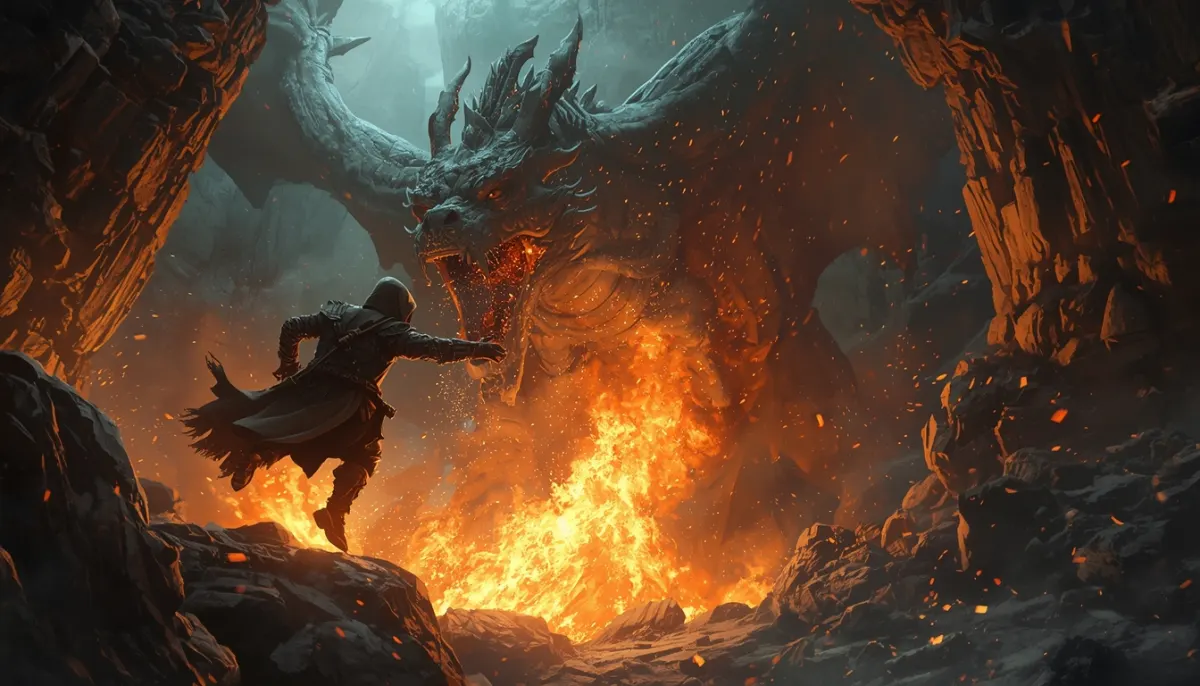
Evasion is a level 7 feature of the Rogue and the Monk. When an effect lets you make a Dexterity saving throw to take only half damage, a success means you take no damage and a failure means you take half. It works on Fireball, Lightning Bolt, a dragon's breath and anything else written "Success: Half damage" on a Dexterity save. It does nothing against attack rolls or other saves, and it switches off while you are Incapacitated. Below: the rule quoted, what it covers, and what it saves a level 7 Rogue against four real breath weapons.
The rule
The Rogue's level 7 feature:
Evasion. You can nimbly dodge out of the way of certain dangers. When you're subjected to an effect that allows you to make a Dexterity saving throw to take only half damage, you instead take no damage if you succeed on the saving throw and only half damage if you fail. You can't use this feature if you have the Incapacitated condition.
The Monk gets the same words at level 7, and the Assassin monster has it as a trait.
Four things follow:
- Dexterity saves only. A Constitution save against poison or a Wisdom save against fear is unchanged.
- Only "half on a success" effects. Fireball says "half as much damage on a successful one", so it qualifies. Sacred Flame deals nothing on a success already, so Evasion adds nothing.
- It is automatic. No action, no Reaction, no uses. It works every time you are in the blast.
- Incapacitated turns it off. Asleep, Stunned, Paralyzed or Unconscious, you take full damage on a fail like anyone else.
Not the same as Uncanny Dodge
The Rogue's level 5 feature covers the other half of the damage you take:
When an attacker that you can see hits you with an attack roll, you can take a Reaction to halve the attack's damage against you (round down).
Uncanny Dodge is for attack rolls and costs your Reaction. Evasion is for Dexterity saves and costs nothing. A level 7 Rogue halves one sword hit a round and shrugs off most of a fireball.
Against real breath weapons
A level 7 Rogue with Dexterity 18 is proficient in Dexterity saves: +4 plus a Proficiency Bonus of +3, so +7. Give them 45 HP (Constitution 12). Damage per breath, on average, with and without Evasion:
| Effect (DC, damage) | Save | Without | With |
|---|---|---|---|
| Mage, Fireball (14, 8d6) | 70% | 18.2 | 4.2 |
| Red Dragon Wyrmling (13, 7d6) | 75% | 15.3 | 3.1 |
| Young Blue Dragon (16, 10d10) | 60% | 38.5 | 11.0 |
| Young Red Dragon (17, 16d6) | 55% | 40.6 | 12.6 |
| Adult Red Dragon (21, 17d6) | 35% | 49.1 | 19.3 |
Evasion cuts the average by 60 to 80 percent. The bigger change is the worst case. Without Evasion, the Young Red Dragon's breath drops a 45 HP Rogue 42.9% of the time and the Adult's 64.0%. With Evasion, only a failed save hurts, and half of 16d6 or 17d6 reaches 45 HP less than 0.1% of the time. The Rogue stays up.
A level 7 Monk with Dexterity 16 saves at +6: 65% against DC 14, 50% against DC 17, 30% against DC 21. The same rule, slightly worse odds.
Raising the odds
Evasion is only as good as the save. Each +1 to the save moves 5% of breaths from half damage to none. Advantage on the save makes failures rarer still: at 55%, Advantage takes the success rate to 79.75%.
The Ring of Evasion goes further:
When you fail a Dexterity saving throw while wearing the ring, you can take a Reaction to expend 1 charge to succeed on that save instead.
On a Rogue with Evasion, every charge turns a half-damage fail into no damage at all. It has 3 charges and regains 1d3 at dawn, and it needs your Reaction, the same Reaction Uncanny Dodge uses. In the Adult Red Dragon's fight, spend the ring on the breath and take the claws at full.
In short
- Who: Rogue and Monk, level 7.
- What: Dexterity save for half damage: success takes none, fail takes half.
- Cost: nothing; it is always on.
- Off when: Incapacitated.
- Not for: attack rolls (that is Uncanny Dodge) or other saves.
The save rules are in Saving Throws; the shapes of the blasts in Areas of Effect.
The odds here are computed exactly from the d20 and the damage dice above. The Book of Dice covers both in Part I, The Object.
This work includes material from the System Reference Document 5.2.1 ("SRD 5.2.1") by Wizards of the Coast LLC, available at dndbeyond.com/srd. The SRD 5.2.1 is licensed under the Creative Commons Attribution 4.0 International License.