Area of Effect in 5e: Cones, Spheres, Lines
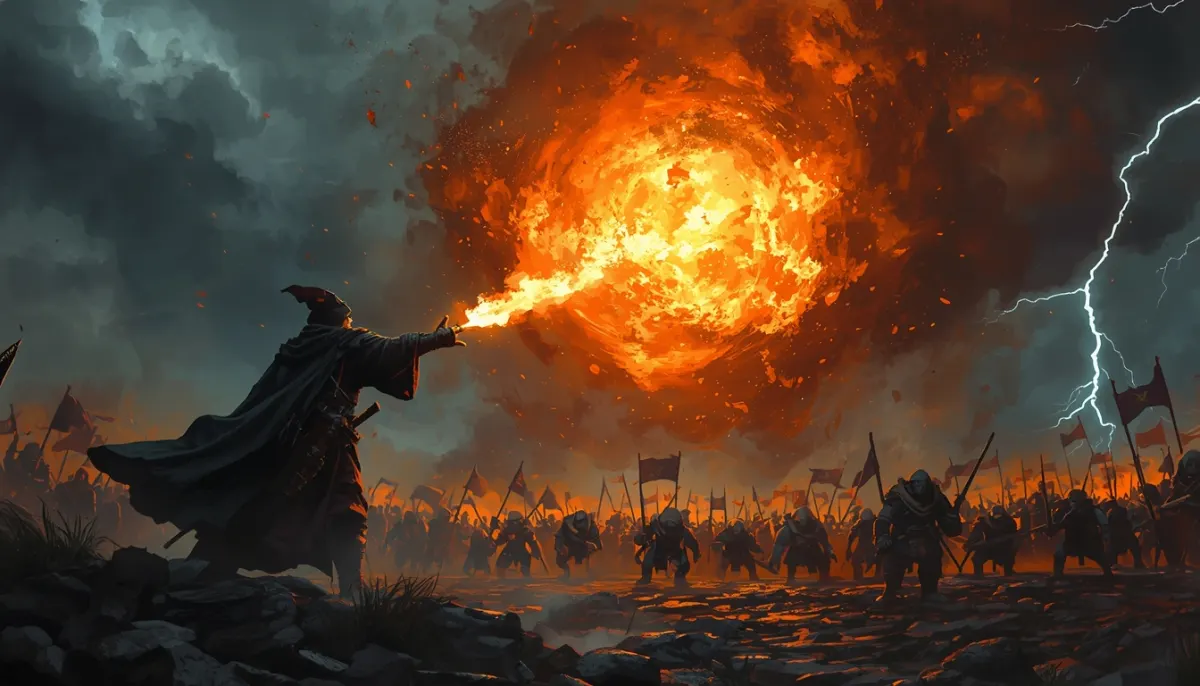
Every area spell uses one of six shapes, Cone, Cube, Cylinder, Emanation, Line or Sphere, each spreading from a point of origin; a spot is outside the area if every straight line from that point to it is blocked. The goblins bunch up in the doorway. The Wizard grins and asks, "How many are in the Fireball?" Answering takes two things: the shape's rules, and a sense of how big that shape is on the table. SRD 5.2.1 gives the first in its Rules Glossary. Here it is, quoted, with the squares counted and the dice worked out.
The six shapes
The description of a spell specifies whether it has an area of effect, which is typically one of these shapes: Cone, Cube, Cylinder, Emanation, Line, or Sphere.
Every shape starts at a point of origin, and one rule covers walls:
An area of effect has a point of origin, a location from which the effect's energy erupts. The rules for each shape specify how to position its point of origin. If all straight lines extending from the point of origin to a location in the area of effect are blocked, that location isn't included in the area of effect. To block a line, an obstruction must provide Total Cover.
So a goblin behind a closed door is safe from a Fireball on the other side. A goblin behind a low wall (Half Cover) is not: the fire still reaches.
Cone
A Cone's width at any point along its length is equal to that point's distance from the point of origin. For example, a Cone is 15 feet wide at a point along its length that is 15 feet from the point of origin. The effect that creates a Cone specifies its maximum length.
A Cone's point of origin isn't included in the area of effect unless its creator decides otherwise.
Burning Hands is a 15-foot Cone from you: 3 squares long, 3 squares wide at the far end, about 4 to 5 squares of floor in all.
Cube
A Cube is an area of effect that extends in straight lines from a point of origin located anywhere on a face of the Cube. The effect that creates a Cube specifies its size, which is the length of each side.
Thunderwave's 15-foot Cube "originating from you" is 3 by 3 squares: 9 squares, pushed out from one face of you. The origin is not inside it unless the creator decides otherwise, so the caster isn't caught.
Sphere
A Sphere is an area of effect that extends in straight lines from a point of origin outward in all directions. The effect that creates a Sphere specifies the distance it extends as the radius of the Sphere.
A Sphere's point of origin is included in the Sphere's area of effect.
Fireball's 20-foot radius is 40 feet across: 8 squares wide, about 50 squares of floor. That is the whole of a small room. Range 150 feet means the Wizard can put it far from the party, and it should be: friends inside it make the save too.
Cylinder
A Cylinder is an area of effect that extends in straight lines from a point of origin located at the center of the circular top or bottom of the Cylinder. The effect that creates a Cylinder specifies the radius of the Cylinder's base and the Cylinder's height.
Flame Strike is "a 10-foot-radius, 40-foot-high Cylinder": 4 squares across, about 12 squares of floor, and tall enough to catch anything flying low.
Line
A Line is an area of effect that extends from a point of origin in a straight path along its length and covers an area defined by its width. The effect that creates a Line specifies its length and width.
Lightning Bolt is "a 100-foot-long, 5-foot-wide Line" from you: one square wide, 20 squares long. It is the shape for a corridor, where a Fireball would wash back.
Emanation
An Emanation is an area of effect that extends in straight lines from a creature or an object in all directions. The effect that creates an Emanation specifies the distance it extends.
An Emanation moves with the creature or object that is its origin unless it is an instantaneous or a stationary effect.
Spirit Guardians fills "a 15-foot Emanation" around the Cleric and walks with them. Counted the SRD's grid way (diagonals cost one square), 15 feet from a Medium creature's square is a 7 by 7 block: 48 squares around the Cleric.
Sizes at a glance
| Spell | Shape | Squares |
|---|---|---|
| Burning Hands | 15 ft Cone | about 4–5 |
| Thunderwave | 15 ft Cube | 9 |
| Flame Strike | 10 ft radius Cylinder | about 12 |
| Lightning Bolt | 100 × 5 ft Line | 20 |
| Spirit Guardians | 15 ft Emanation | 48 |
| Fireball | 20 ft radius Sphere | about 50 |
"About" because circles and triangles don't fit squares. SRD 5.2.1 has no rule for a square the area only partly covers. Agree one at your table before the first Fireball, not during it.
Worked: how many goblins drop
A Goblin Warrior has AC 15, 10 Hit Points, Dexterity 15 (+2) and Constitution 10 (+0). Our Wizard has Intelligence 16.
- Burning Hands, level 1 Wizard, DC 13. The goblin fails the Dexterity save on 10 or lower: 50%. A failed save takes 3d6, which reaches 10 62.5% of the time. Half of 3d6 never reaches 10. So each goblin drops 31.25%. With three in the Cone, at least one drops 67.5% of the time.
- Thunderwave, level 1 Wizard, DC 13. The goblin fails the Constitution save 60%, and is pushed 10 feet. 2d8 reaches 10 43.75% of the time. Each goblin drops 26.25%, but 60% of them end up two squares further away.
- Fireball, level 5 Wizard, DC 14. The goblin fails 55%. 8d6 (average 28) drops it every time on a failed save, and half of 8d6 still reaches 10 96% of the time. Each goblin drops 98.2%. Four goblins in the Sphere all drop 93% of the time.
- Lightning Bolt, level 5 Wizard, DC 14. Same 8d6, same save, same 98.2% per goblin. The difference is shape: line them up in a corridor.
So at level 1 an area spell thins a group. At level 5 it ends one.
At the table
- Name the origin first. Fireball: a point in range. Burning Hands, Thunderwave, Lightning Bolt: you. Spirit Guardians: you, and it moves.
- Count squares, not feet. Divide by 5. A 20-foot radius is 4 squares out from the centre.
- Walls stop it, low walls don't. Only Total Cover blocks the area.
- Allies make the save too, unless the spell lets you leave them out, as Spirit Guardians does.
Our 3D roller throws 8d6 in one go. The Book of Dice explains notation like 8d6 in its Dice Notation Guide, in Part III, The Rolling.
This work includes material from the System Reference Document 5.2.1 ("SRD 5.2.1") by Wizards of the Coast LLC, available at dndbeyond.com/srd. The SRD 5.2.1 is licensed under the Creative Commons Attribution 4.0 International License.