D&D Dice Explained: What Each Die Is For
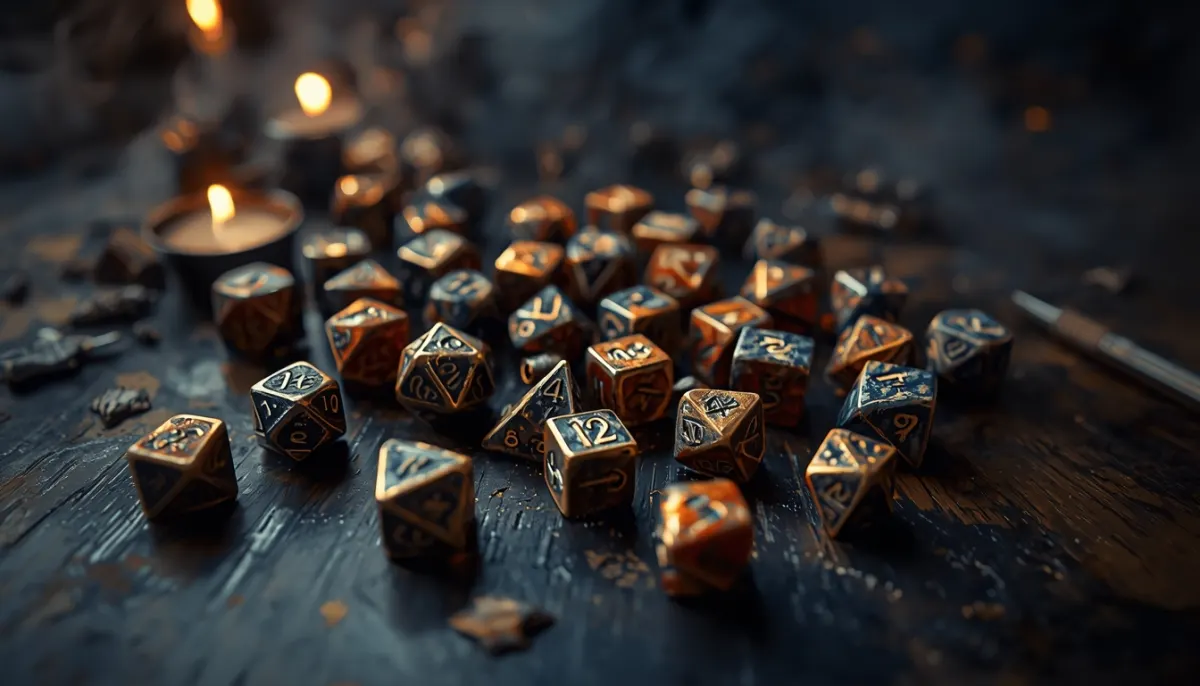
A standard set holds seven dice: d4, d6, d8, d10, d12, d20, and a second d10 marked in tens. New players often hold the bag and ask which one to throw. The answer is simpler than it looks. One die decides whether something works. The rest measure how much.
Every rule quoted here comes from the System Reference Document 5.2.1, the free rules the 2024 game is built on.
The d20 decides
When the outcome is in doubt, you roll the d20. The SRD names these rolls:
When the outcome of an action is uncertain, the game uses a d20 roll to determine success or failure. These rolls are called D20 Tests, and they come in three kinds: ability checks, saving throws, and attack rolls.
So the d20 answers yes-or-no questions. Can you climb the wall? Do you resist the poison? Does the arrow hit? You add a modifier, compare the total to a number (a Difficulty Class, or the target's Armor Class), and meet it or miss it.
Two special results sit on this die only. On an attack roll, a natural 20 "hits regardless of any modifiers or the target's AC" and is a Critical Hit; a natural 1 "misses regardless of any modifiers or the target's AC."
Two d20s at once
Advantage and Disadvantage use a second d20. In the SRD's words: "Use the higher of the two rolls if you have Advantage, and use the lower roll if you have Disadvantage." Keep two d20s of different colours in the bag and you never have to ask which roll came first.
The small dice measure
Once the d20 says yes, a smaller die says how much. Mostly that is damage, and the weapon decides the die. From the SRD's weapon table:
| Die | Weapons that use it |
|---|---|
| d4 | Dagger, Club, Dart, Sling, Sickle, Whip, Light Hammer |
| d6 | Shortsword, Scimitar, Mace, Quarterstaff, Spear, Javelin, Handaxe, Shortbow |
| d8 | Longsword, Rapier, Battleaxe, Warhammer, Morningstar, Longbow, Light Crossbow |
| d10 | Glaive, Halberd, Pike, Lance, Heavy Crossbow |
| d12 | Greataxe |
| 2d6 | Greatsword, Maul |
Bigger dice mean heavier weapons. The Greataxe's d12 and the Greatsword's 2d6 have the same maximum, 12, but 2d6 lands near 7 far more often. The d12 is swingier: as likely to roll a 1 as a 12.
A Critical Hit doubles the dice, not the total. The SRD's own example: "if you score a Critical Hit with a Dagger, roll 2d4 for the damage rather than 1d4, and add your relevant ability modifier."
Hit Point Dice: the same dice, measuring you
Each class has a Hit Point Die, and its size tells you how much punishment the class is built to take.
| Hit Point Die | Classes |
|---|---|
| d6 | Sorcerer, Wizard |
| d8 | Bard, Cleric, Druid, Monk, Rogue, Warlock |
| d10 | Fighter, Paladin, Ranger |
| d12 | Barbarian |
The SRD says "At level 1, your character has 1 Hit Die," and you gain more as you level. They are also a resource: you "can spend Hit Dice during a Short Rest to recover Hit Points." A Barbarian spending a d12 heals far more than a Wizard spending a d6, which is the point.
The d6, four at a time
The d6 has one more job, at the very start. The SRD's random way to make ability scores:
Roll four d6s and record the total of the highest three dice. Do this five more times, so you have six numbers.
If you would rather not gamble, the SRD gives a fixed set to place where you like: "15, 14, 13, 12, 10, 8." Both routes are built into our character creator.
The d10 pair: d100
The two d10s together make a d100. The convention at most tables: roll both, read the tens die first, then the ones die; 00 and 0 together read as 100. You need it for random tables. The SRD's own trinket table, for one, runs 1d100.
Monsters use the same dice
Monster stat blocks run on exactly these dice. A Goblin Warrior's scimitar deals "5 (1d6 + 2)" and its Hit Points are "10 (3d6)". The number in front is the average; the dice in brackets are what you roll if you want the fight a little less predictable. We take one goblin apart number by number in how to read a stat block.
A quick sort for the bag
- d20: will it work? Checks, saves, attacks, initiative.
- d4 to d12: how much? Damage and healing, by weapon, spell and class.
- 4d6, drop the lowest: your ability scores, once.
- d10 + d10: d100, for tables.
Learn those four lines and you will never again hold up a d8 and ask the table what it does.
This work includes material from the System Reference Document 5.2.1 ("SRD 5.2.1") by Wizards of the Coast LLC, available at dndbeyond.com/srd. The SRD 5.2.1 is licensed under the Creative Commons Attribution 4.0 International License.