
How to Find and Disarm Traps in 5e
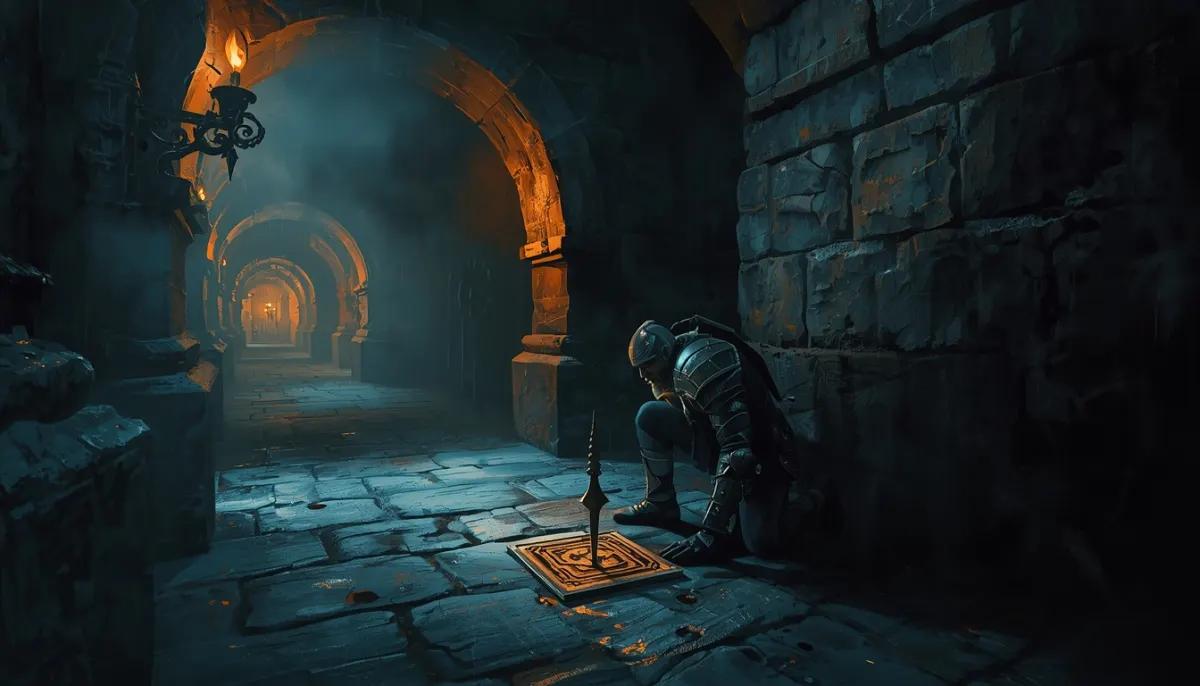
You find a trap by taking the action it names, usually Search with a Wisdom (Perception) check, or Study with Intelligence (Investigation) for the pits and the Rolling Stone; an Iron Spike wedged in place stops five of the seven. A trap is a monster with no turn. It waits, it fires once, and the fight is over before anyone rolls Initiative. The SRD gives seven example traps and a short set of rules for using them. Here they are, quoted, with the odds worked out for a level 1 party: a Wizard (Dex +2, 7 HP), a Rogue (Dex +3, 9 HP) and a Fighter (Dex +0, 12 HP).
What the SRD asks of a trap
The first rule is advice to the Game Master:
Traps should be used sparingly, lest they lose their charm. A hidden pit can be a fun surprise, but too many traps in an adventure can lead players to become overly cautious, which slows down the game.
And the test of a good one:
Traps that are undetectable and inescapable are rarely fun.
Every trap has three parts: severity, trigger and duration. Severity matters most:
A nuisance trap is unlikely to seriously harm characters of the indicated levels, whereas a deadly trap can grievously damage characters of the indicated levels.
The SRD warns that the label slides with level: "A trap that is a nuisance at one level range could be deadly to characters of a lower level range."
The seven traps
| Trap | Severity | Save | Damage |
|---|---|---|---|
| Collapsing Roof | Deadly 1–4 | Dex DC 13 | 2d10, half on save |
| Falling Net | Nuisance 1–4 | Dex DC 10 | Restrained |
| Fire-Casting Statue | Deadly 1–4 | Dex DC 15 | 2d10 Fire, half on save |
| Hidden Pit | Nuisance 1–4 | none | 1d6 |
| Poisoned Darts | Deadly 1–4 | Dex DC 13 | 1d3 darts × 1d6 |
| Poisoned Needle | Nuisance 1–4 | Con DC 11 | 1d10 + Poisoned |
| Spiked Pit | Deadly 1–4 | none | 1d6 + 2d8 |
The Rolling Stone stands apart: deadly at levels 11–16, a nuisance at 17–20.
Which ones drop a level 1 hero
| Trap | Wizard | Rogue | Fighter |
|---|---|---|---|
| Collapsing Roof | 56.5% | 35.7% | 27.0% |
| Fire-Casting Statue | 62.2% | 42.3% | 31.5% |
| Poisoned Darts | 24.8% | 15.3% | 8.1% |
| Poisoned Needle | 18.0% | 9.0% | 0% |
| Spiked Pit | 94.8% | 85.4% | 60.2% |
The pits have no save at all. A creature that steps on the lid falls, and the Spiked Pit deals "3 (1d6) Bludgeoning damage from the fall plus 9 (2d8) Piercing damage from the spikes." That is 12.5 on average, more than a level 1 Fighter's whole pool six times in ten. The only defence is finding the lid first.
The Fire-Casting Statue is worse than its numbers. It resets "at the start of the next turn," and fires when a creature "moves onto this trap's pressure plate for the first time on a turn or starts its turn there." A Wizard who drops on the plate takes another Cone next round.
Finding them: Search or Study
Each trap names the action and the check. Most use Search:
When you take the Search action, you make a Wisdom check to discern something that isn't obvious.
The pits and the Rolling Stone use Study and Intelligence (Investigation) instead, DC 15: the lid is "constructed from material identical to the surrounding floor," so looking harder doesn't help; thinking does.
| Check | +0 | +3 | +5 | +7 |
|---|---|---|---|---|
| DC 10 (statue glyph) | 55% | 70% | 80% | 90% |
| DC 11 (trip wires) | 50% | 65% | 75% | 85% |
| DC 15 (plates, holes, needle, pits) | 30% | 45% | 55% | 65% |
Trip wires are easy: DC 11, and once found "the trip wire can be easily cut or avoided (no ability check required)." Pressure plates and pits sit at DC 15, where one hero at +3 misses more often than not. Four heroes at +0, +1, +3 and +5 each taking a Search action find a DC 15 plate 88.7% of the time.
The SRD trap entries mention no passive check. They say "As a Search action" or "As a Study action." A party that walks without looking gets no roll.
The Iron Spike beats five traps
Five of the seven end the same way. For the pressure plates:
Wedging an Iron Spike or similar object under the pressure plate prevents the trap from triggering.
For the pits, the spike goes "between the pit's lid and the surrounding floor to prevent the lid from opening, thereby making it safe to cross." That covers the Fire-Casting Statue, Poisoned Darts, Rolling Stone, Hidden Pit and Spiked Pit. Iron Spikes cost 1 GP for ten. A Pole (5 CP) is "10 feet long. You can use it to touch something up to 10 feet away."
The others have their own answers:
- Darts: "Plugging all the holes with wax, cloth, or detritus prevents the darts from firing."
- Statue: find the glyph (DC 10), read it with a Study action (DC 15 Intelligence (Arcana)), then "use a sharp tool to deface the glyph, which disarms the trap." Detect Magic shows "an aura of Evocation magic."
- Needle: "The trap doesn't trigger if the lock is opened using a Knock spell or similar magic." Otherwise a DC 15 Dexterity (Sleight of Hand) check, and "On a failed check, the creature triggers the trap." A level 1 Rogue with Expertise (+7) disarms it 65% of the time.
- Net: a trapped creature or an ally takes an action for a DC 10 Strength (Athletics) check. A Fighter at +5 cuts free 80% of the time.
Getting out of a pit
Falling in is half the trap. The walls are smooth:
A creature needs a Climb Speed, climbing gear, or magic such as Spider Climb to scale the pit's smooth walls.
Bring rope. The SRD suggests the Game Master can soften it "by adding cracks in the walls big enough to serve as handholds and footholds."
The Rolling Stone
The one trap that takes turns. When it triggers, "The stone and all creatures nearby roll Initiative; the stone gets a +8 bonus on its Initiative roll." It moves 60 feet a turn, and:
Whenever the stone enters a creature's space for the first time on a turn or a creature enters the stone's space while the stone is rolling, that creature must succeed on a DC 15 Dexterity saving throw or take 55 (10d10) Bludgeoning damage and have the Prone condition.
No half damage on a success: the save is all or nothing. A level 11 Wizard at Dex +2 with 57 HP fails 60% of the time and drops 26.1% of the time. Stopping it takes a DC 20 Strength (Athletics) check per action, each success cutting 15 feet. A level 11 Fighter at +9 succeeds half the time, so four successes to stop it is a team job. Or break it: "AC 17, HP 100, a Damage Threshold of 10."
Scaling up
Every trap has an "At Higher Levels" table. The Spiked Pit at levels 5–10 is 30 feet deep and deals 3d6 plus 3d8 (24 on average), still with no save. Collapsing Roof and Fire-Casting Statue reach 18d10 at levels 17–20. The Poisoned Needle climbs to 10d10 at DC 17.
In short
- Pits have no save. Search before you step.
- Trip wires are DC 11; plates and pits DC 15. Everyone searches.
- Carry Iron Spikes. Ten for 1 GP stop five of the seven traps.
- The Fire-Casting Statue fires every turn. Get off the plate.
- The Rolling Stone is all or nothing. Spike the plate.
The Book of Dice covers the d20, the DC and why 15 feels so much harder than 11 in Part III, The Rolling.
This work includes material from the System Reference Document 5.2.1 ("SRD 5.2.1") by Wizards of the Coast LLC, available at dndbeyond.com/srd. The SRD 5.2.1 is licensed under the Creative Commons Attribution 4.0 International License.