
5e Jumping and Falling Rules Explained
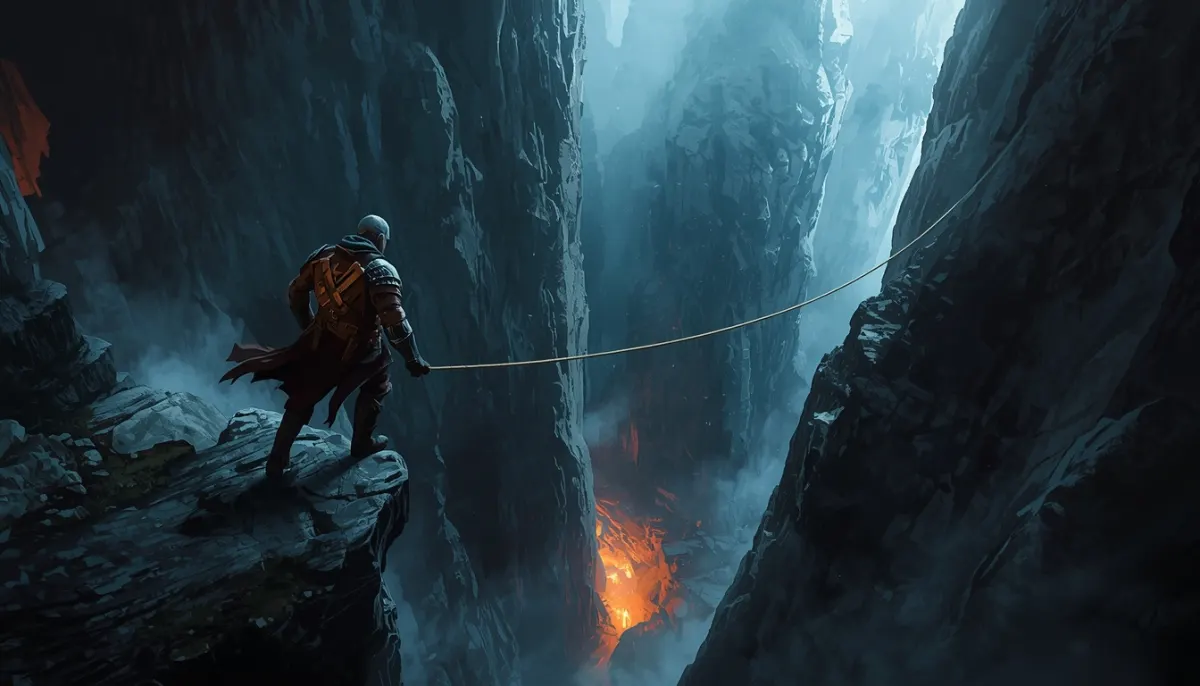
A running Long Jump carries you up to your Strength score in feet, a running High Jump 3 plus your Strength modifier, and a fall deals 1d6 Bludgeoning damage per 10 feet, to a maximum of 20d6. The bridge is out. Twelve feet of air to the far ledge, and a long way down. Two questions decide the next minute: can you make the jump, and what happens if you don't. SRD 5.2.1 answers both in a few lines each. Here they are, quoted, with the numbers worked out.
The long jump
Long Jump. When you make a Long Jump, you leap horizontally a number of feet up to your Strength score if you move at least 10 feet immediately before the jump. When you make a standing Long Jump, you can leap only half that distance. Either way, each foot you jump costs a foot of movement.
Note the word score, not modifier. A Strength 16 Fighter clears 16 feet with a run-up, 8 standing. A Strength 8 Wizard clears 8 feet, 4 standing. No roll: you make it or you don't.
Two extras ride on the landing and the take-off:
If you land in Difficult Terrain, you must succeed on a DC 10 Dexterity (Acrobatics) check or have the Prone condition.
At your GM's option, you must succeed on a DC 10 Strength (Athletics) check to clear a low obstacle (no taller than a quarter of the jump's distance), such as a hedge or low wall. Otherwise, you hit the obstacle.
The Fighter's 16-foot jump can clear a wall up to 4 feet high. With Athletics +5 the DC 10 check passes on a 5 or better: 80%.
The high jump
High Jump. When you make a High Jump, you leap into the air a number of feet equal to 3 plus your Strength modifier (minimum of 0 feet) if you move at least 10 feet on foot immediately before the jump. When you make a standing High Jump, you can jump only half that distance.
You can extend your arms half your height above yourself during the jump. Thus, you can reach a distance equal to the height of the jump plus 1½ times your height.
Here it is the modifier. The Fighter (+3) jumps 6 feet with a run, 3 standing. The Wizard (−1) jumps 2 feet, 1 standing.
Reach is where the high jump earns its keep. A 6-foot Fighter with a running high jump reaches 6 + 9 = 15 feet: enough to grab a ledge, a chandelier or a rope end that looked out of reach.
| Running | Long | High | Reach |
|---|---|---|---|
| Fighter, Str 16 | 16 ft | 6 ft | 15 ft |
| Wizard, Str 8 | 8 ft | 2 ft | 11 ft |
Standing, halve each jump. Reach assumes 6 feet tall.
Both jumps cost movement. A Speed 30 Fighter who runs 10 feet and jumps 16 has 4 feet left.
Falling
Falling [Hazard]. A creature that falls takes 1d6 Bludgeoning damage at the end of the fall for every 10 feet it fell, to a maximum of 20d6. When the creature lands, it has the Prone condition unless it avoids taking any damage from the fall.
The cap arrives at 200 feet. Past that, height stops mattering.
| Fall | Damage | Average |
|---|---|---|
| 10 ft | 1d6 | 3.5 |
| 20 ft | 2d6 | 7 |
| 30 ft | 3d6 | 10.5 |
| 60 ft | 6d6 | 21 |
| 100 ft | 10d6 | 35 |
| 200 ft or more | 20d6 | 70 |
Worked: who survives the drop
The level 1 Wizard has 7 Hit Points (d6 Hit Die, Constitution 12). The level 3 Fighter has 28.
- Wizard, 20 feet. 2d6 rolls 7 or more 58% of the time. One storey, and the Wizard is more likely than not at 0 Hit Points.
- Wizard, 30 feet. 3d6 rolls 7 or more 91% of the time.
- Fighter, 60 feet. 6d6 reaches 28 only 6% of the time.
- Fighter, 100 feet. 10d6 reaches 28 92% of the time.
So a 20-foot drop threatens a fresh Wizard the way a 100-foot drop threatens a seasoned Fighter.
Falling into water
A creature that falls into water or another liquid can use its Reaction to make a DC 15 Strength (Athletics) or Dexterity (Acrobatics) check to hit the surface head or feet first. On a successful check, any damage resulting from the fall is halved.
The Fighter, Athletics +5, needs an 11: 50%. On a success, 10d6 halved almost never reaches 28. Across both outcomes the 100-foot fall into a lake drops the Fighter 46% of the time, down from 92% onto rock. It costs the Fighter's Reaction.
Feather Fall
Feather Fall. Level 1 Transmutation (Bard, Sorcerer, Wizard). Casting Time: Reaction, which you take when you or a creature you can see within 60 feet of you falls.
Choose up to five falling creatures within range. A falling creature's rate of descent slows to 60 feet per round until the spell ends. If a creature lands before the spell ends, the creature takes no damage from the fall, and the spell ends for that creature.
The spell lasts 1 minute: 10 rounds at 60 feet each is 600 feet of safe descent. It is a Reaction, so a Wizard who keeps a level 1 slot for it turns the whole falling table above into zero, for up to five people.
At the table
- Say the distance before the roll. "It's 12 feet" lets a player compare against their Strength score and decide. No roll needed if they have it.
- Score for long, modifier for high. The usual mix-up. Write both on the sheet.
- Prone on landing unless the fall dealt no damage. Standing up costs "an amount of movement equal to half your Speed".
- Water halves only on the check. No check, full damage.
Our 3D roller throws the 10d6 for you. The Book of Dice explains notation like 10d6 in its Dice Notation Guide, in Part III, The Rolling.
This work includes material from the System Reference Document 5.2.1 ("SRD 5.2.1") by Wizards of the Coast LLC, available at dndbeyond.com/srd. The SRD 5.2.1 is licensed under the Creative Commons Attribution 4.0 International License.