How to Run a D&D One-Shot: Three Fights
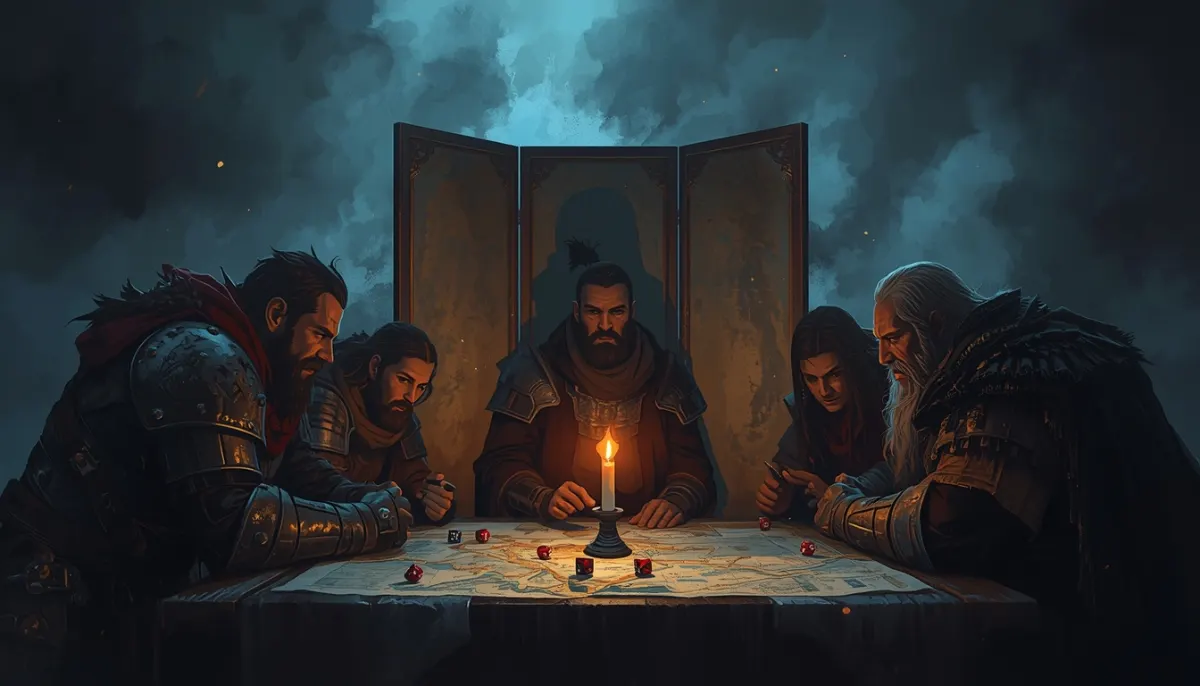
To run a one-shot, plan three scenes with a fight in each, rising from Low to High difficulty on the SRD's XP budget. A one-shot is a whole adventure in one sitting. No campaign, no homework, nobody needs to remember last month. It is the best way to bring new players to the table, and the easiest game to run badly: too many fights, one fight too hard, or a story still half told when the pizza runs out.
The System Reference Document 5.2.1 gives a Game Master everything needed to size it right. Here is a one-shot for four level 1 characters, built from its numbers.
The shape of the evening
The SRD names "the three main pillars of D&D play": "social interaction, exploration, and combat." A one-shot wants all three, and wants them in order of rising stakes.
Plan three scenes with a fight in each, and let the talking and exploring sit between them:
- The hook and a Low fight. Someone asks for help; the road there has teeth.
- The approach and a Moderate fight. The party finds the lair and has to get in.
- The end and a High fight. The thing behind it all, and a reason to run, bargain or win.
Three fights fit a four-hour evening. A fourth almost never does.
Step 1: choose how hard
The SRD sorts every fight into three difficulties.
Low Difficulty. An encounter of low difficulty is likely to have one or two scary moments for the players, but their characters should emerge victorious with no casualties.
Moderate Difficulty. Absent healing and other resources, an encounter of moderate difficulty could go badly for the adventurers.
High Difficulty. A high-difficulty encounter could be lethal for one or more characters.
Low, Moderate, High is the arc of the night. The table feels clever in the first fight, stretched in the second and frightened in the third.
Step 2: the budget
Each difficulty has an XP budget per character. The SRD's rule: "Multiply the number in the table by the number of characters in the party to get your XP budget for the encounter."
For a level 1 party, the table reads:
| Difficulty | Per character | Four characters |
|---|---|---|
| Low | 50 | 200 |
| Moderate | 75 | 300 |
| High | 100 | 400 |
Step 3: spend it
"Every creature has an XP value in its stat block," and you spend the budget as close to the total as you can "without going over."
Goblins suit a first one-shot. In SRD 5.2.1 a Goblin Warrior is "CR 1/4 (XP 50; PB +2)" and a Goblin Boss is "CR 1 (XP 200; PB +2)". That gives three fights from two stat blocks:
| Fight | Monsters | XP | Budget |
|---|---|---|---|
| Low: the road | 4 Goblin Warriors | 200 | 200 |
| Moderate: the gate | 6 Goblin Warriors | 300 | 300 |
| High: the boss | 1 Goblin Boss and 4 Goblin Warriors | 400 | 400 |
Every fight lands on its budget exactly. Swap in any monster from the SRD with the same arithmetic; the budget does not care what the creature is.
The warnings worth reading
The SRD lists the ways an encounter breaks. Three matter most at level 1.
Many creatures. "If your encounter includes more than two creatures per character, include fragile creatures that can be defeated quickly. This guideline is especially important for characters of level 1 or 2." Six goblins against four characters stays under that line. Ten would not.
Powerful creatures. A monster with a Challenge Rating above the party's level "might deal enough damage with a single action to take out one or more characters." The SRD's own example: "an Ogre (CR 2) can kill a level 1 Wizard with a single blow." An Ogre at the end of a level 1 one-shot is not a boss fight. It is a coin toss with a character's life.
Too many stat blocks. "Referencing more than two or three stat blocks for a single encounter can be daunting." Two stat blocks for the whole night, as above, leaves you free to describe and to listen.
Between the fights
Fights eat hit points, and a one-shot has no next session to heal in. Give the party one quiet scene between the second fight and the third. The SRD defines it: "A Short Rest is a 1-hour period of downtime, during which a creature does nothing more strenuous than reading, talking, eating, or standing watch." At the end the characters may spend Hit Point Dice to heal. A captured goblin to question during that hour turns the rest into the social scene the evening needs.
Make it fit the clock
- Keep a timer in sight. Start the last fight with an hour to spare.
- Hand out ready-made characters, or give each player ten minutes in a builder before you start.
- Cut, don't stretch. If the second fight drags, a goblin flees to warn the boss, and the third scene begins.
- End on a choice: the boss offers a deal. The table remembers a choice longer than the last hit.
Characters for the table come from our builder, and the app keeps the party and its campaign notes on your device. Our 3D roller throws for anyone who forgot dice. Every rule above is in the SRD 5.2.1, "Gameplay Toolbox" and "Rules Glossary".
This work includes material from the System Reference Document 5.2.1 ("SRD 5.2.1") by Wizards of the Coast LLC, available at dndbeyond.com/srd. The SRD 5.2.1 is licensed under the Creative Commons Attribution 4.0 International License.