
Potions in 5e, Drinking, Mixing and Brewing
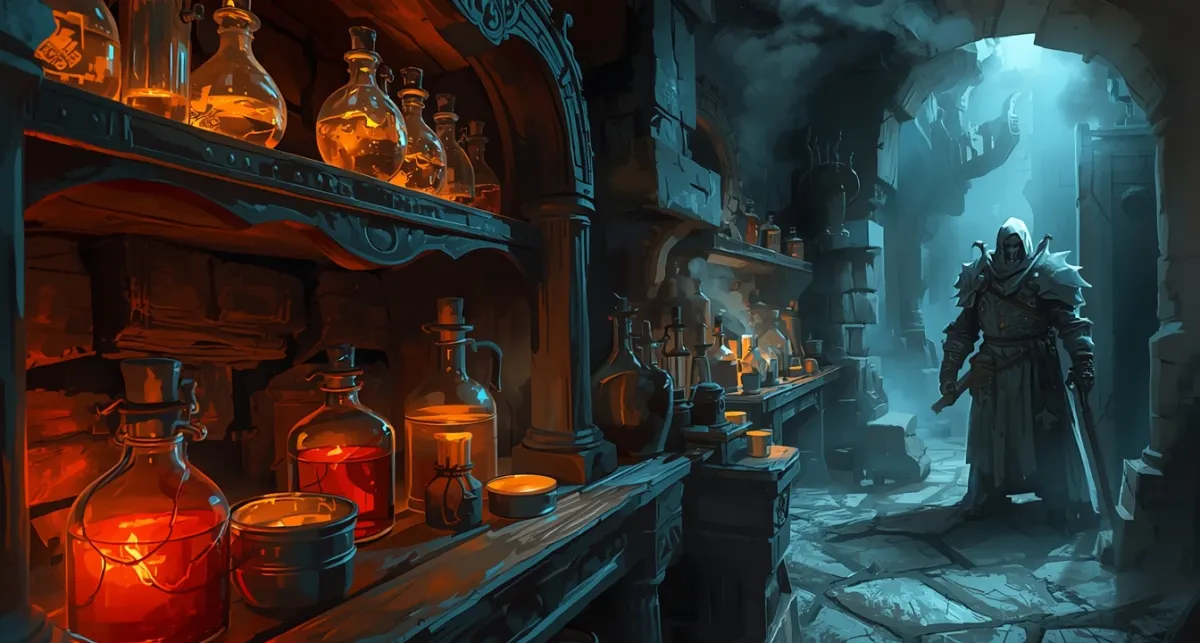
Drinking a potion, or pouring it into an ally within 5 feet, costs a Bonus Action, and it works at once. A Potion of Healing restores 2d4 + 2, and the rarest restores 10d4 + 20. Drink two at once, or pour them into one bottle, and the GM rolls d100 on a table that runs from "both work" to an explosion. Here are the rules from SRD 5.2.1, quoted, with the odds worked out.
Using a potion
The SRD's Potions category:
Using a Potion. Potions are consumable items. Drinking a potion or administering it to another creature requires a Bonus Action. Applying an oil might take longer as specified in its description. Once used, a potion takes effect immediately, and it is used up.
The Potion of Healing entry in Equipment adds the range: "another creature within 5 feet of yourself." So the Fighter can still attack, then pour a potion into the downed Wizard beside them on the same turn. Any healing gets a creature at 0 Hit Points back up.
You don't need Identify to learn what a potion does: "a little taste is enough to tell the taster what a potion does."
The four Potions of Healing
| Potion | Heals | Average | Rarity | Price | GP per HP |
|---|---|---|---|---|---|
| Healing | 2d4 + 2 | 7 | Common | 50 GP | 7 |
| Greater | 4d4 + 4 | 14 | Uncommon | 200 GP | 14 |
| Superior | 8d4 + 8 | 28 | Rare | 2,000 GP | 71 |
| Supreme | 10d4 + 20 | 45 | Very Rare | 20,000 GP | 444 |
The basic price is the Equipment list's 50 GP. The others come from the Magic Item Rarities and Values table (Uncommon 400 GP, Rare 4,000, Very Rare 40,000), with its footnote: "Halve the value for a consumable item other than a Spell Scroll."
What each one does to a hurt hero:
- A basic potion heals 7 or more 62.5% of the time, 9 or more 18.8%, and never more than 10.
- A Greater heals 12 or more 86.3% of the time, 16 or more 25.8%.
- A Superior heals 30 or more 32.0% of the time.
- A Supreme never heals less than 30, and heals 50 or more 10.3% of the time.
For comparison, Cure Wounds with a +3 modifier averages 12 and costs an action and a slot. A basic potion costs 50 GP and a Bonus Action, and anyone can drink one.
Mixing potions
The rule: "A character might drink one potion while still under the effects of another or pour several potions into a single container. The strange ingredients used in creating potions can result in unpredictable interactions." When that happens, the GM rolls on the Potion Miscibility table; for more than two potions, "roll again for each subsequent potion, combining the results."
| d100 | Result | Chance |
|---|---|---|
| 01 | Both lose their effects; 5-foot-radius explosion, 4d10 Force damage to each creature in it | 1% |
| 02–08 | Both lose their effects; the mix becomes an ingested poison | 7% |
| 09–15 | Both lose their effects | 7% |
| 16–25 | One potion loses its effect | 10% |
| 26–35 | Both work, numbers and durations halved | 10% |
| 36–90 | Both work normally | 55% |
| 91–99 | Both work, one potion's numbers and duration doubled | 9% |
| 00 | Only one works, but its effect is permanent | 1% |
Read it as odds:
- Both potions work in full 55% of the time; 91–00 (10%) does better.
- One mix in four (rolls 01–25) wastes at least one potion.
- One in twelve (01–08) hurts: the explosion averages 22 Force damage to everyone within 5 feet, and the poison is the GM's pick.
- Three potions at once means two rolls. Both come up 36–90 only 30.3% of the time.
The 00 result's own example: a Potion of Healing "might increase the drinker's Hit Point maximum by 2d4 + 2." A 1% lottery ticket. Drink potions one at a time unless the table wants the gamble.
The potion that lies
Potion of Poison. This concoction looks, smells, and tastes like a Potion of Healing or another beneficial potion. However, it is actually poison masked by illusion magic. Identify reveals its true nature.
The taste test fails here: it tastes like the real thing. Drinking it deals 4d6 Poison damage (average 14) plus a DC 13 Constitution save against the Poisoned condition for 1 hour. With Con +0 you fail 60% of the time; with +2, 50%. A potion from a dead cultist's belt deserves Identify before it goes into the downed Wizard.
Brewing your own
Brewing Potions of Healing. A character who has proficiency with the Herbalism Kit can create a Potion of Healing. Doing so requires using that kit and 25 GP of raw material over the course of 1 day (8 hours of work).
Half the shop price, about 3.6 GP per Hit Point. The Herbalism Kit costs 5 GP. The stronger potions follow the general magic item rules: proficiency in Arcana, plus Alchemist's Supplies or the Herbalism Kit. Consumables cost half the time and gold on the crafting table, so a Greater potion takes 5 days and 100 GP, and a Superior 25 days and 1,000 GP.
Other potions worth knowing
- Potion of Resistance (Uncommon): Resistance to one damage type for 1 hour, the GM's choice or a d10 roll (Acid, Cold, Fire, Force, Lightning, Necrotic, Poison, Psychic, Radiant, Thunder).
- Potion of Heroism (Rare): 10 Temporary Hit Points and Bless for 1 hour, no Concentration.
- Potion of Invisibility (Rare): Invisible for 1 hour; it ends if you attack, deal damage or cast a spell.
- Potion of Speed (Very Rare): Haste for 1 minute, no Concentration, and no lethargy when it ends.
- Potion of Vitality (Very Rare): removes every Exhaustion level, ends Poisoned, and for 24 hours every Hit Point Die you spend heals its maximum.
At the table
- A potion is a Bonus Action. Attack, then drink, on the same turn.
- Pour, don't wait: anyone within 5 feet can revive a downed ally with one.
- One potion at a time. Mixing wastes one in four.
- Identify unknown red vials before you trust them.
- Anyone with an Herbalism Kit turns 25 GP and a quiet day into a potion.
The Book of Dice covers the d4 behind every healing potion in Part I, The Object.
This work includes material from the System Reference Document 5.2.1 ("SRD 5.2.1") by Wizards of the Coast LLC, available at dndbeyond.com/srd. The SRD 5.2.1 is licensed under the Creative Commons Attribution 4.0 International License.