
How Does Attunement Work in 5e?
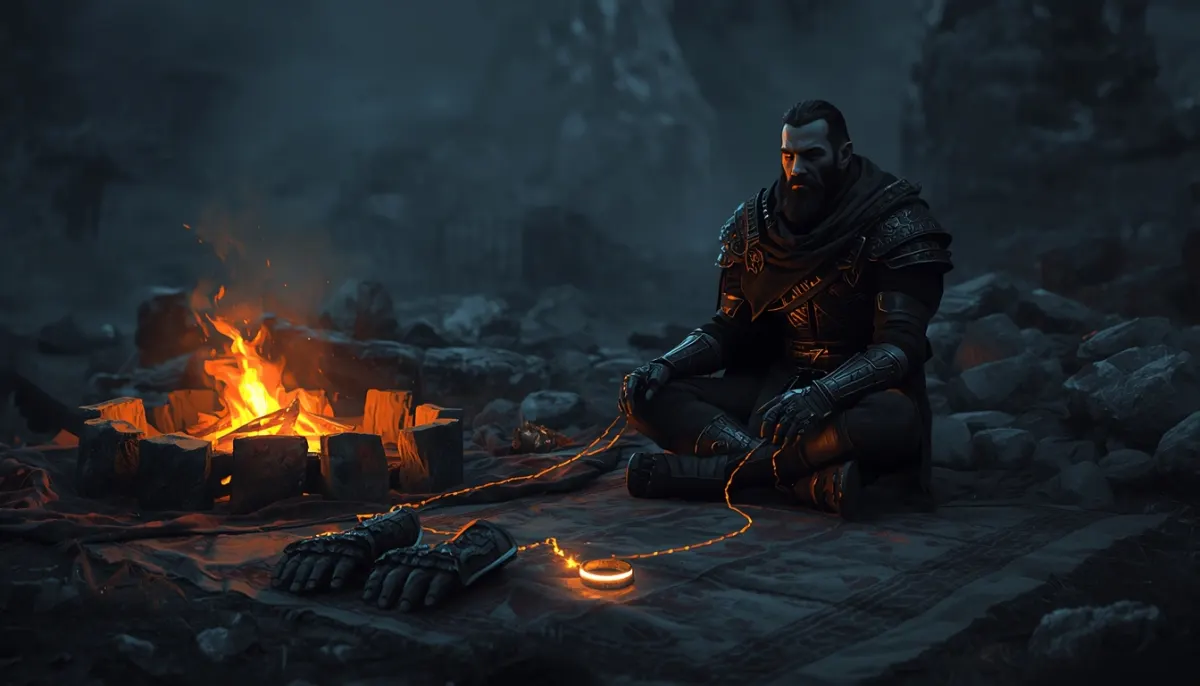
Attuning to a magic item takes a Short Rest in contact with it, and you can be attuned to no more than three items at once, never two copies of the same one. The dragon's hoard is open. There's a cloak, a ring, a pair of gauntlets, an amulet and a wand on the pile, and every one of them says "Requires Attunement." You can use three. Here are the SRD 5.2.1 rules for that bond, quoted, and the numbers behind which three to pick.
What Attunement is
Some magic items require a creature to form a bond—called Attunement—with them before the creature can use an item's magical properties. Without becoming attuned to an item that requires Attunement, you gain only its nonmagical benefits unless its description states otherwise.
The SRD's own example: a magic Shield that needs Attunement still works as a normal Shield in unattuned hands, "but none of its magical properties." A Flame Tongue is still a sword. Gauntlets of Ogre Power are still gloves.
You can tell which items ask for the bond from the line under the name: "Wondrous Item, Uncommon (Requires Attunement)." Roughly half the items at every rarity from Uncommon up carry it. Plain +1, +2 and +3 Weapons, Armor and Shields don't, and neither does a Bag of Holding.
An hour per item
Attuning to an item requires you to spend a Short Rest focused on only that item while being in physical contact with it (this can't be the same Short Rest used to learn the item's properties).
A Short Rest "is a 1-hour period of downtime." The focus can be "weapon practice (for a Weapon), meditation (for a Wand), or some other appropriate activity." If anything interrupts the rest, "the Attunement attempt fails."
Learning what an item does is a separate step. Either cast Identify, or:
you can focus on one magic item during a Short Rest while being in physical contact with the item. At the end of the rest, you learn its properties and how to use them (but not any curse the item might bear).
So the hoard above costs time. Five unknown items, three to keep: five hours to learn them all, then three more to attune, eight hours in all. Identify is a level 1 Ritual, so a Wizard who has it cuts out the five learning hours for no slots at all. The party that rests in the dragon's lair to do this should expect company.
No more than three
You can be attuned to no more than three magic items at a time. Any attempt to attune to a fourth item fails; you must end your Attunement to an item first. Additionally, you can't attune to more than one copy of an item. For example, you can't attune to more than one Ring of Protection at a time.
Note what that sentence doesn't forbid: two different items. A Cloak of Protection and a Ring of Protection both say the same thing, "You gain a +1 bonus to Armor Class and saving throws," and the only limit the SRD sets is one copy of each. Wear both and you have +2.
The one class feature in the SRD that raises the limit belongs to the Rogue's Thief subclass, at level 13:
Use Magic Device. You can attune to up to four magic items at once.
What ends it
Your Attunement to an item ends if you no longer satisfy the prerequisites for Attunement, if the item has been more than 100 feet away for at least 24 hours, if you die, or if another creature attunes to the item. You can also voluntarily end Attunement by spending another Short Rest focused on the item unless the item is cursed.
Four things in there catch players out:
- Lending is free for a day. Hand your Cloak of Protection to the Rogue for the night watch and you are still attuned in the morning, as long as it came back inside 24 hours or stayed within 100 feet.
- A thief can take the bond. If the creature who stole your ring sits down for a Short Rest with it, your Attunement ends.
- Death wipes the slots. The revival rules say it again: "If the creature had Attunement to one or more magic items, it is no longer attuned to them." Revivify brings you back with three empty slots and three hours of work.
- Swapping costs two hours. One Short Rest to end the old bond, one to make the new one.
Who can attune
If a magic item has a class prerequisite, a creature must be a member of that class to attune to the item. If a creature must be a spellcaster to attune to an item, the creature qualifies if it can cast at least one spell using its traits or features, not by using a magic item or the like.
The SRD items with a prerequisite:
| Item | Who can attune |
|---|---|
| Pearl of Power, every Wand that asks (Fireballs, Lightning Bolts, Paralysis, Polymorph, Web, War Mage) | Any spellcaster |
| Hat of Many Spells | Wizard |
| Robe of the Archmagi, Staff of Power, Staff of the Magi | Sorcerer, Warlock or Wizard |
| Staff of Fire, Staff of Frost | Druid, Sorcerer, Warlock or Wizard |
| Staff of Charming, Staff of Swarming Insects | Bard, Cleric, Druid, Sorcerer, Warlock or Wizard |
| Staff of Healing | Bard, Cleric or Druid |
| Staff of the Woodlands | Druid |
| Necklace of Prayer Beads | Cleric, Druid or Paladin |
| Talisman of Pure Good | Cleric or Paladin |
| Holy Avenger | Paladin |
| Dwarven Thrower | A Dwarf, or a creature attuned to a Belt of Dwarvenkind |
"Traits" matters. An Elf's lineage hands out a cantrip, so an Elf Fighter counts as a spellcaster and can attune to a Wand of Fireballs. A Human Fighter holding the same wand doesn't, because the wand itself can't be the spell that qualifies you.
Curses
Attunement to a cursed item can't be ended voluntarily unless the curse is broken first, such as with a Remove Curse spell.
And Identify won't warn you: "Most methods of identifying items, including the Identify spell, fail to reveal such a curse." The SRD's Berserker Axe is the clean example. It gives +1 to hit and damage and more Hit Points, then:
Curse. This weapon is cursed, and becoming attuned to it extends the curse to you. As long as you remain cursed, you are unwilling to part with the weapon, keeping it within reach at all times. You also have Disadvantage on attack rolls with weapons other than this one.
A cursed item also sits in one of your three slots until someone casts Remove Curse.
Worth a slot? The numbers
Protection. A Goblin Warrior attacks at +4. Each point of AC takes 5 percentage points off its hit chance:
| Your AC | Goblin hits |
|---|---|
| 16 (Chain Mail) | 45% |
| 17 (+ Cloak of Protection) | 40% |
| 18 (+ Ring of Protection) | 35% |
Two slots turn one hit in every 2.2 swings into one in 2.9. The same +1s land on every saving throw too: a Con +2 hero against a DC 15 save goes 40% → 45% → 50%. Bracers of Defense do the AC half, +2, but only "if you are wearing no armor and using no Shield," so they suit a Monk, or a Wizard under Mage Armor (which also needs a target wearing no armor).
Strength. Gauntlets of Ogre Power make your Strength 19 (+4). A Str 16 Fighter swinging a Greatsword at AC 15:
| Setup | Hits | Average damage per swing |
|---|---|---|
| Str 16, plain Greatsword | 55% | 5.85 |
| Gauntlets (Str 19) | 60% | 6.95 |
| +1 Greatsword, no Gauntlets | 60% | 6.95 |
| Both | 65% | 8.15 |
For this Fighter the Gauntlets and a +1 weapon are the same number, and the +1 weapon takes no slot. The Gauntlets earn their slot on a character with low Strength, and they say so: "They have no effect on you if your Strength is 19 or higher without them." The Amulet of Health and Headband of Intellect work the same way for Constitution and Intelligence. A Con 12 Wizard holding Concentration against 10 damage (DC 10) goes from 60% to 75% with the Amulet.
Staying alive. The Periapt of Wound Closure (Uncommon) says:
Life Preservation. Whenever you make a Death Saving Throw, you can change a roll of 9 or lower to a 10, turning a failed save into a successful one.
Every roll becomes a success, so death saves alone can no longer kill you. Left on the floor without it, a hero dies 40.5% of the time; with it, never by the dice (damage taken at 0 Hit Points still counts). Three straight successes make you Stable, and a natural 20 on the way (14.3%) gets you up with 1 Hit Point. Its other half doubles what Hit Point Dice restore: a Fighter's d10 + 2 goes from 7.5 to 15 on average.
Picking the three
- Take the items that do something nothing else does first: a Periapt of Wound Closure, a Cloak of Displacement, Boots of Speed.
- Weigh a stat item against your current score. Gauntlets of Ogre Power on a Str 18 Fighter give +0 to hit (18 and 19 are both +4).
- Weapons and armor with a plain +1 cost no slot. Don't leave one in the bag to make room.
- Keep track of the hours. Every swap is two Short Rests, and a death means three hours of attuning before the next fight.
- Write the three on your sheet. "Attuned" is a line on the character sheet for a reason.
The Book of Dice covers the d20 behind every attack roll and save in Part III, The Rolling.
This work includes material from the System Reference Document 5.2.1 ("SRD 5.2.1") by Wizards of the Coast LLC, available at dndbeyond.com/srd. The SRD 5.2.1 is licensed under the Creative Commons Attribution 4.0 International License.