
How Difficult Terrain Works in 5e
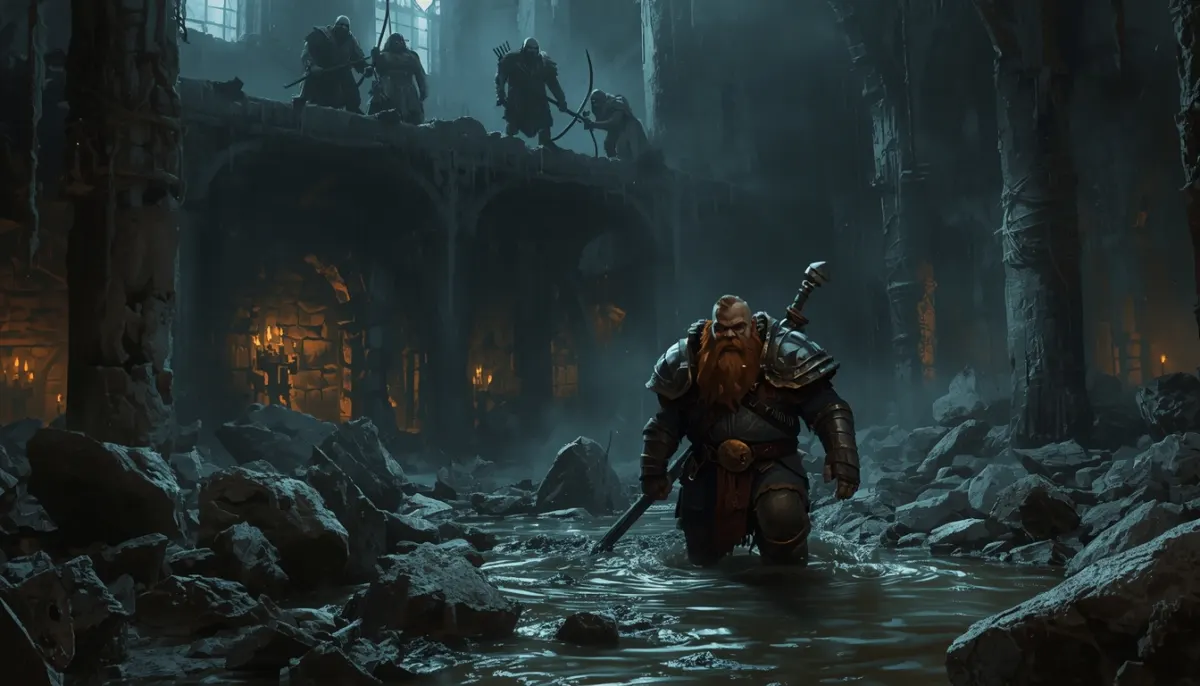
Every foot of movement in Difficult Terrain costs 1 extra foot, so 5 feet costs 10, and it never stacks. Most fights happen on a floor nobody describes. Then the GM says "rubble", and half the table's plans stop working. Difficult Terrain is one of the shortest rules in the game and one of the most used. Here it is, what it costs, and the numbers on turning the ground into a weapon.
The rule
If a space is Difficult Terrain, every foot of movement in that space costs 1 extra foot. For example, moving 5 feet through Difficult Terrain costs 10 feet of movement. Difficult Terrain isn't cumulative; either a space is Difficult Terrain or it isn't.
On a grid it reads the same way: "A square of Difficult Terrain costs 2 squares to enter."
The SRD lists what makes a space difficult:
A space is Difficult Terrain if the space contains any of the following or something similar:
- A creature that isn't Tiny or your ally
- Furniture that is sized for creatures of your size or larger
- Heavy snow, ice, rubble, or undergrowth
- Liquid that's between shin- and waist-deep
- A narrow opening sized for a creature one size smaller than you
- A slope of 20 degrees or more
Two lines in that list catch players out. Every enemy's space counts, so slipping past a foe costs double even where the rules let you through. And a Medium hero in a tunnel built for Small creatures pays double the whole way.
It never stacks
Rubble under waist-deep water under a collapsed table is still one extra foot per foot. The combat chapter says it again: "even if multiple things in a space count as Difficult Terrain." The GM never needs to add up layers. A space is difficult, or it isn't.
Dash, climbing, crawling
Difficult Terrain does not lower your Speed. It raises the price of each foot. That matters for Dash:
When you take the Dash action, you gain extra movement for the current turn. The increase equals your Speed after applying any modifiers.
Dash doubles your movement, and the terrain still charges double, so a Dash through rubble covers what a plain walk covers on open ground.
Climbing, crawling and swimming each carry their own extra cost, and the glossary says how it meets the terrain: "each foot of movement costs 1 extra foot (2 extra feet in Difficult Terrain)." With a Climb Speed or Swim Speed, "you ignore this extra cost."
For a hero with Speed 30 and no climb or swim Speed:
| Moving by | Open ground | Difficult Terrain | With Dash in it |
|---|---|---|---|
| Walking | 30 ft | 15 ft | 30 ft |
| Climbing or swimming | 15 ft | 10 ft | 20 ft |
| Crawling | 15 ft | 10 ft | 20 ft |
Crawling matters because of Prone. A Prone creature's "only movement options are to crawl or to spend an amount of movement equal to half your Speed (round down) to right yourself." Stand up in rubble with Speed 30 and 15 feet remain, which buys 7 feet of rubble: one square on a grid.
Slippery ice
Ice gets its own rule on top:
Slippery ice is Difficult Terrain. A creature that moves onto slippery ice for the first time on a turn or starts its turn there must succeed on a DC 10 Dexterity saving throw or have the Prone condition.
A DC 10 save fails when the d20 plus your Dexterity save comes to 9 or less:
| Dexterity save | Falls Prone |
|---|---|
| −1 | 50% |
| +0 | 45% |
| +2 | 35% |
| +3 | 30% |
Jumping onto bad ground has a similar cost. Land a Long Jump in Difficult Terrain and "you must succeed on a DC 10 Dexterity (Acrobatics) check or have the Prone condition."
Making the ground your weapon
Several spells create Difficult Terrain on purpose. Two show the range.
Grease (level 1, Sorcerer and Wizard) covers a 10-foot square "and turns it into Difficult Terrain for the duration." Each creature standing there "must succeed on a Dexterity saving throw or have the Prone condition," and one that "enters the area or ends its turn there must also succeed on that save or fall Prone."
Against a Wizard with Intelligence 16 (save DC 13), a Goblin Warrior (Dexterity +2) falls 50% of the time; an Ogre (Dexterity −1) falls 65%. A creature that falls inside the grease pays half its Speed to stand, then double for every foot out, and saves again if its turn ends there. An Ogre's Speed 40 leaves 20 feet after standing: 10 feet of grease.
Spike Growth (level 2, Druid and Ranger, Concentration) turns a 20-foot-radius Sphere into Difficult Terrain and adds a bill:
When a creature moves into or within the area, it takes 2d4 Piercing damage for every 5 feet it travels.
No save. The damage counts feet travelled, not movement spent, so the terrain halves how far a creature gets and the spikes charge for every 5 feet of it. A Goblin Warrior has 10 Hit Points:
| Goblin Warrior travels inside | Damage | Average | Goblin drops |
|---|---|---|---|
| 5 ft | 2d4 | 5 | 0% |
| 10 ft | 4d4 | 10 | 58.6% |
| 15 ft (its whole turn) | 6d4 | 15 | 97.9% |
An Ogre crossing the full 40-foot width takes 16d4, 40 damage on average, out of 68 Hit Points. At Speed 40 it covers only 20 feet a turn in there, so the crossing takes two turns unless it Dashes. Remember the Ogre carries Javelins: the spikes slow its club, not its throw.
The spell also hides itself. A creature that "can't see the area when the spell is cast must take a Search action and succeed on a Wisdom (Perception or Survival) check against your spell save DC to recognize the terrain as hazardous before entering it."
Ways past it
Freedom of Movement (level 4) lasts an hour, and for that hour "the target's movement is unaffected by Difficult Terrain." On a long journey the travel rules note that a group flying, or whose "special movement allows them to ignore Difficult Terrain," can "move at a Fast pace regardless of the terrain."
At the table
GMs: say "difficult" when you describe a room, not after a player moves. Mark it on the map. Players: count your feet before you commit, and when the ground is bad for you, it is bad for them. A melee foe on the far side of a bog spends a turn reaching you.
For what to do with a turn the ground has eaten, see Dodge, Dash or Disengage. For holding a spell like Spike Growth up under fire, see Concentration, and for long trips over bad ground, Travel Pace.
This work includes material from the System Reference Document 5.2.1 ("SRD 5.2.1") by Wizards of the Coast LLC, available at dndbeyond.com/srd. The SRD 5.2.1 is licensed under the Creative Commons Attribution 4.0 International License.