
How Far Can You Travel in a Day in 5e?
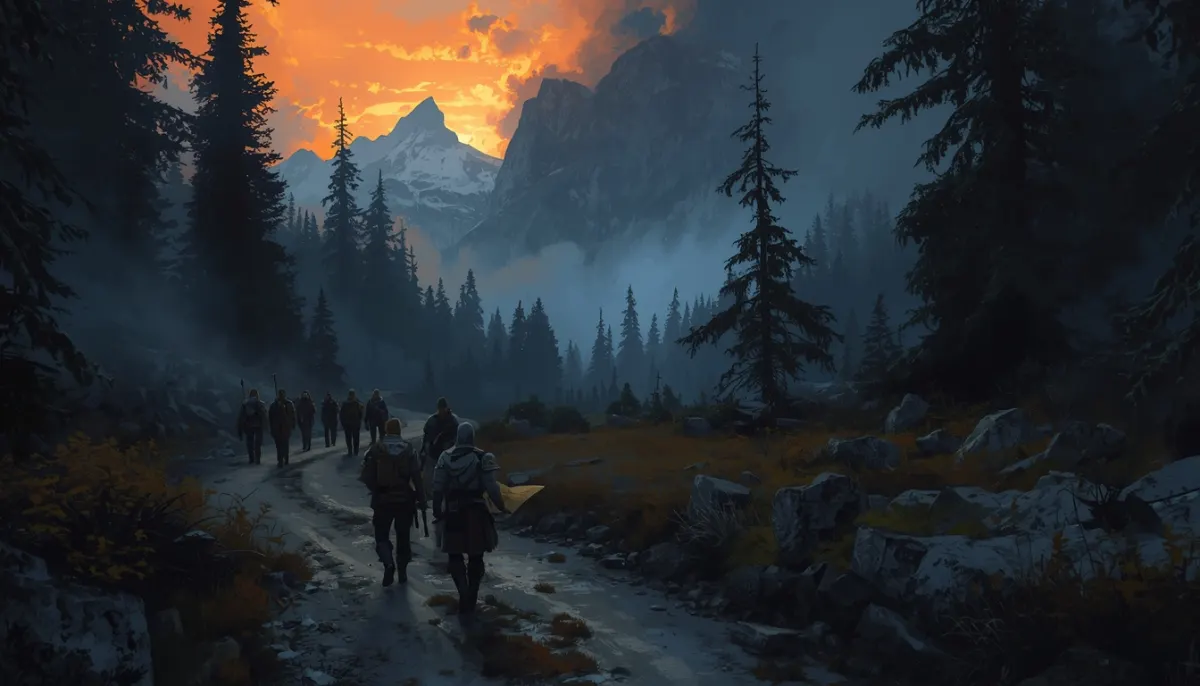
A party covers 24 miles a day at Normal pace, 30 at Fast and 18 at Slow; Fast imposes Disadvantage on Perception, Survival and Stealth, and Slow grants Advantage on Perception and Survival. The town is three days away. Most tables wave the trip through in a sentence, and the SRD lets you: "The GM can summarize this travel without calculating exact distances or travel times." But when the clock matters, or the party is lost, or something is hunting them, the travel rules decide who sees what and who arrives tired. They are short. Here they are, quoted, with the numbers worked out.
Three paces
While traveling outside combat, a group can move at a Fast, Normal, or Slow pace, as shown on the Travel Pace table.
| Pace | Minute | Hour | Day |
|---|---|---|---|
| Fast | 400 feet | 4 miles | 30 miles |
| Normal | 300 feet | 3 miles | 24 miles |
| Slow | 200 feet | 2 miles | 18 miles |
Speed buys a price at the table:
Fast. Traveling at a Fast pace imposes Disadvantage on a traveler's Wisdom (Perception or Survival) and Dexterity (Stealth) checks.
Normal. Traveling at a Normal pace imposes Disadvantage on Dexterity (Stealth) checks.
Slow. Traveling at a Slow pace grants Advantage on Wisdom (Perception or Survival) checks.
Notice what that means. Only a Slow party sneaks without Disadvantage, and even then gets no bonus to Stealth. Normal pace already makes you loud.
Take a scout with Perception +5 looking for something at DC 15. A plain roll needs a 10: 55%. At a Slow pace, Advantage lifts it to 79.75%. At a Fast pace, Disadvantage drops it to 30.25%. Six extra miles a day costs more than half the scout's chance of spotting the trap.
Horses: twice as fast, for an hour
If riding horses or other mounts, the group can move twice that distance for 1 hour, after which the mounts need a Short or Long Rest before they can move at that increased pace again.
A mounted party at Normal pace covers 6 miles in that hour instead of 3. It is a sprint, not a new cruising speed. Save it for the hour that matters: outrunning a storm, reaching the bridge before the riders.
Terrain sets the ceiling
The Gameplay Toolbox caps the pace by ground:
During any journey stage, the predominant terrain determines the characters' maximum travel pace, as shown in the Maximum Pace column of the Travel Terrain table.
| Terrain | Max pace | Encounter | Nav DC |
|---|---|---|---|
| Arctic | Fast (skis) | 6d6 × 10 ft | 10 |
| Coastal | Normal | 2d10 × 10 ft | 5 |
| Desert | Normal | 6d6 × 10 ft | 10 |
| Forest | Normal | 2d8 × 10 ft | 15 |
| Grassland | Fast | 6d6 × 10 ft | 5 |
| Hill | Normal | 2d10 × 10 ft | 10 |
| Mountain | Slow | 4d10 × 10 ft | 15 |
| Swamp | Slow | 2d8 × 10 ft | 15 |
| Underdark | Normal | 2d6 × 10 ft | 10 |
| Urban | Normal | 2d6 × 10 ft | 15 |
| Waterborne | Special | 6d6 × 10 ft | 10 |
Arctic carries a note: "Appropriate equipment (such as skis) is necessary to keep up a Fast pace in Arctic terrain." The full table also lists Foraging and Search DCs for each terrain.
Encounter distance tells you how far off a meeting starts. In a forest, 2d8 × 10 averages 90 feet: close enough to charge. On grassland, 6d6 × 10 averages 210 feet: time to talk, hide or run. In a city, 2d6 × 10 averages 70 feet, a street's width.
The Navigation DC is the number to beat. SRD 5.2.1 gives the DC and leaves the rest to the GM: which check, and what a miss means. If your GM calls for Wisdom (Survival), pace matters again. A guide with Survival +4 against the forest's DC 15 needs an 11: 50%. Slow pace makes it 75%. Fast pace isn't allowed in a forest anyway, unless there's a road.
Roads, and the slowest walker
Good Roads. The presence of a good road increases the group's maximum pace by one step (from Slow to Normal or from Normal to Fast).
Slower Travelers. The group must move at a Slow pace if any group member's Speed is reduced to half or less of normal.
So a forest road allows Fast: 30 miles a day instead of 24. A mountain pass with a good road allows Normal: 24 miles instead of 18. And one companion with a halved Speed pins the whole group to 18 miles a day, wherever they walk.
Past eight hours
Characters can push themselves to travel for more than 8 hours per day, at the risk of tiring. At the end of each additional hour of travel beyond 8 hours, each character must succeed on a Constitution saving throw or gain 1 Exhaustion level. The DC is 10 plus 1 for each hour past 8 hours.
A character with Constitution +2 passes hour 9 (DC 11) on a 9 or better, 60%, and hour 10 (DC 12) on a 10 or better, 55%. The chance of two extra hours with no Exhaustion at all: 33%. Exhaustion costs 2 on every D20 Test per level, so two hours of road usually cost the next day's fights.
Flying over all of it
If the characters are flying or their special movement allows them to ignore Difficult Terrain, they can move at a Fast pace regardless of the terrain.
The Toolbox turns any Speed into miles: "Miles per hour = Speed ÷ 10", times the hours travelled (typically 8) for a Normal day, then "× 1⅓ (round down)" for Fast. A 4 × 6 foot Carpet of Flying has a Fly Speed of 60 feet: 6 miles an hour, 48 miles at Normal, 64 at Fast. Over the mountains that walkers cross at 18 miles a day, the carpet covers more than three times the ground.
The short version
- Pick the pace for the danger, not the distance. Fast loses Perception, Survival and Stealth. Slow wins Perception and Survival.
- Terrain caps it; a road lifts it one step; one slow companion drops it to Slow.
- Encounter distance is a roll. Roll it when the meeting starts, not after.
- Past eight hours, every hour is a Constitution save, and the DC climbs.
Our 3D roller throws the 2d8, 6d6 or 4d10 for you. The Book of Dice explains notation like 6d6 × 10 in its Dice Notation Guide, in Part III, The Rolling.
This work includes material from the System Reference Document 5.2.1 ("SRD 5.2.1") by Wizards of the Coast LLC, available at dndbeyond.com/srd. The SRD 5.2.1 is licensed under the Creative Commons Attribution 4.0 International License.