How Two-Weapon Fighting Works in 5e
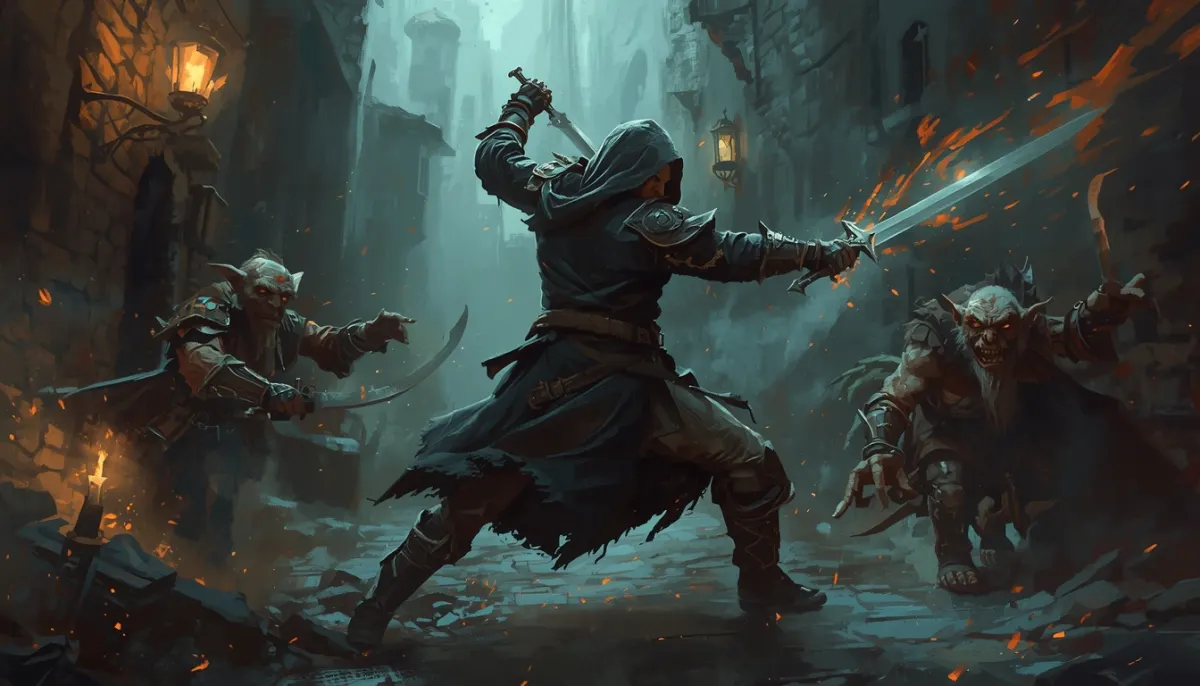
Attack with a Light weapon and you can make one extra attack as a Bonus Action with a different Light weapon, without adding your ability modifier to its damage unless you have the Two-Weapon Fighting feat. A blade in each hand looks great on a character sheet. In SRD 5.2.1 it is three short rules: the Light property gives the second attack, a feat adds damage to it, and a mastery frees the Bonus Action it costs. Here is what each one is worth.
The Light property
When you take the Attack action on your turn and attack with a Light weapon, you can make one extra attack as a Bonus Action later on the same turn. That extra attack must be made with a different Light weapon, and you don't add your ability modifier to the extra attack's damage unless that modifier is negative.
Four conditions hide in that sentence:
- You must take the Attack action, and attack with a Light weapon.
- The second attack costs your Bonus Action.
- It needs a different Light weapon. A Dagger and another Dagger count; one Shortsword swung twice does not.
- The second hit deals only its die. No Strength or Dexterity on top.
The Light weapons in the SRD:
| Weapon | Damage | Also | Mastery |
|---|---|---|---|
| Club | 1d4 Bludgeoning | Slow | |
| Dagger | 1d4 Piercing | Finesse, Thrown | Nick |
| Handaxe | 1d6 Slashing | Thrown | Vex |
| Light Hammer | 1d4 Bludgeoning | Thrown | Nick |
| Sickle | 1d4 Slashing | Nick | |
| Scimitar | 1d6 Slashing | Finesse | Nick |
| Shortsword | 1d6 Piercing | Finesse | Vex |
The Two-Weapon Fighting feat
Fighters pick a Fighting Style feat at level 1; Paladins and Rangers at level 2. One of them:
When you make an extra attack as a result of using a weapon that has the Light property, you can add your ability modifier to the damage of that attack if you aren't already adding it to the damage.
So the second blade hits as hard as the first.
Nick, the mastery that frees the Bonus Action
When you make the extra attack of the Light property, you can make it as part of the Attack action instead of as a Bonus Action. You can make this extra attack only once per turn.
Fighters, Rogues, Barbarians, Paladins and Rangers all start with Weapon Mastery. Master a Dagger, Light Hammer, Sickle or Scimitar, and the second attack no longer eats your Bonus Action. A Rogue keeps Cunning Action for Disengage or Hide. A Fighter keeps Second Wind. Our weapon mastery post covers all eight masteries.
Nick also helps with drawing. The Attack action lets you equip one weapon with each attack you make as part of it:
You can either equip or unequip one weapon when you make an attack as part of this action.
A Bonus Action attack is not part of the Attack action, so it has no draw of its own. With Nick, the second attack becomes part of the Attack action, and it can draw the second blade. Without Nick, draw both before the fight.
Level 1 Fighter against a Goblin Warrior
A level 1 Fighter with Dexterity 16 (or Strength 16) hits with +5. A Goblin Warrior has AC 15 and 10 Hit Points, so each swing hits 55% of the time, 5% as a critical.
| Loadout | Damage per turn | Goblin down in one turn |
|---|---|---|
| Rapier, or Longsword and Shield | 4.35 | 16.3% |
| Shortsword and Scimitar | 5.85 | 21.1% |
| Shortsword and Scimitar, Two-Weapon Fighting feat | 7.50 | 30.8% |
| Greatsword | 5.85 | 34.1% |
Two blades without the feat average exactly what a Greatsword does, yet drop the goblin far less often. Two small hits rarely add up to 10; one 2d6+3 hit reaches 10 more than half the time. With the feat, two blades out-damage the Greatsword by 1.65 a turn and nearly match it on the one-turn kill.
The price is the shield. The goblin's Scimitar hits with +4: 45% against AC 16 in Chain Mail, 35% with a Shield on top. The Longsword and Shield Fighter deals 3.15 less damage per turn than the two-blade one with the feat, and gets hit about a fifth less often.
Level 5: Extra Attack closes the gap
At level 5 the Fighter's bonus rises to +6 and Extra Attack gives two attacks per Attack action. The Light property still gives only one extra attack.
| Loadout | Damage per turn |
|---|---|
| Greatsword, two attacks | 12.70 |
| Shortsword twice, Scimitar once, with the feat | 12.22 |
| Shortsword twice, Scimitar once, no feat | 10.43 |
The Greatsword's 2d6 per swing now counts twice; the extra blade still counts once. Two weapons are strongest at levels 1 to 4, and stay close after that only with the feat.
The Rogue's real reason
Sneak Attack lands once per turn, on the first hit that qualifies. Two attacks are two chances to land it. A level 1 Rogue, Dexterity 16, with an ally beside the goblin:
| Loadout | Chance to land Sneak Attack | Damage per turn | Goblin down in one turn |
|---|---|---|---|
| Rapier | 55% | 6.45 | 39.3% |
| Shortsword and Scimitar | 79.75% | 8.89 | 49.0% |
The second blade adds only 1d6 of its own, but it lifts the Sneak Attack chance from 55% to almost 80%. With Nick on the Scimitar, the Rogue still has the Bonus Action to Disengage and step away.
Which hero should carry two
- Rogue: yes. Shortsword and Scimitar, master both, Nick on the Scimitar.
- Fighter, Ranger or Paladin taking the feat: a strong pick for the first four levels. After level 5 a Greatsword pulls ahead, unless you want a Nick weapon's free Bonus Action.
- Anyone else without the feat: a Shield is usually worth more than a die with no modifier.
This work includes material from the System Reference Document 5.2.1 ("SRD 5.2.1") by Wizards of the Coast LLC, available at dndbeyond.com/srd. The SRD 5.2.1 is licensed under the Creative Commons Attribution 4.0 International License.