
How Tool Proficiency Works in 5e
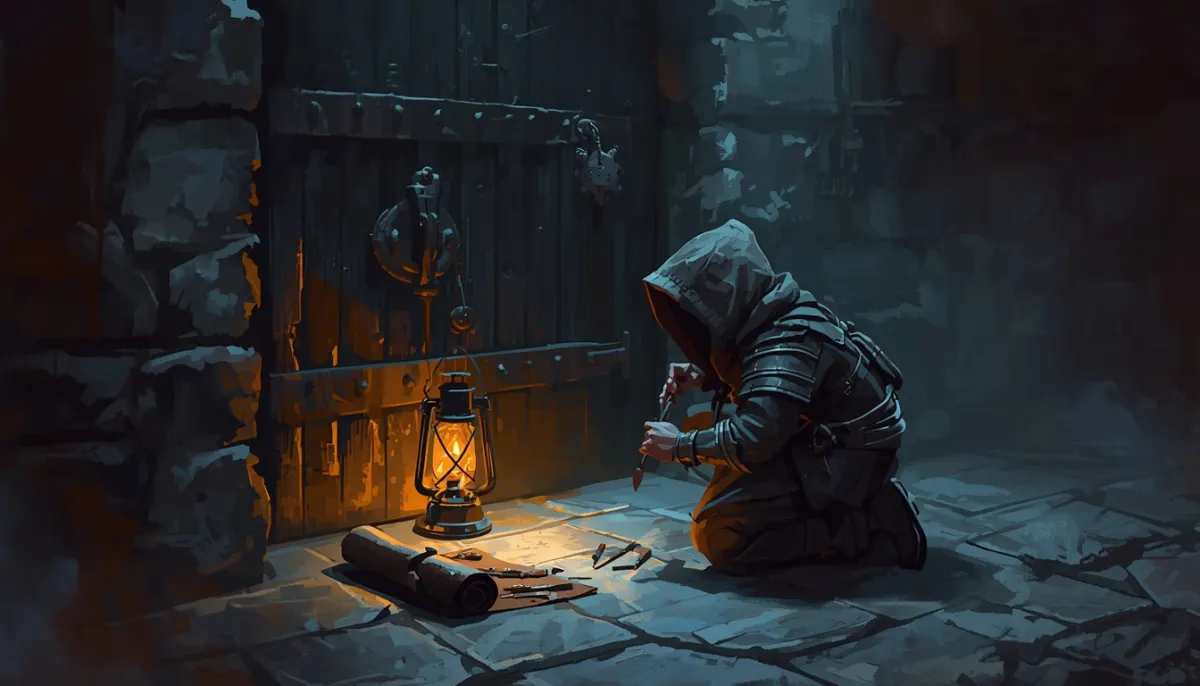
Tool proficiency adds your Proficiency Bonus to any check you make with that tool, and if you're also proficient in a skill the check uses, you have Advantage. Every background hands you one tool. Most players write it down and forget it. The rule behind that line is short, and it does more than it looks: a bonus, sometimes Advantage, a list of things you can do with one action, and a way to make gear for half price. Here it is, quoted from the SRD, with the odds.
The rule
The SRD's equipment chapter:
If you have proficiency with a tool, add your Proficiency Bonus to any ability check you make that uses the tool. If you have proficiency in a skill that's used with that check, you have Advantage on the check too.
The second sentence is the one tables miss. A tool and a skill on the same check do not compete. The tool gives the bonus; the skill adds Advantage. The rules on proficiency say it plainly:
This means you can benefit from both skill proficiency and tool proficiency on the same ability check.
Where your tools come from
Each background gives a character proficiency with one tool—either a specific tool or one chosen from the Artisan's Tools category.
In the SRD's four backgrounds:
| Background | Tool |
|---|---|
| Acolyte | Calligrapher's Supplies |
| Criminal | Thieves' Tools |
| Sage | Calligrapher's Supplies |
| Soldier | One kind of Gaming Set |
Four classes add more: the Bard picks three Musical Instruments, the Druid gets the Herbalism Kit, the Monk picks one Artisan's Tools or Musical Instrument, and the Rogue gets Thieves' Tools.
The Utilize action
Each tool lists what it does in one action:
Utilize. This entry lists things you can do with the tool when you take the Utilize action. You can do one of those things each time you take the action. This entry also provides the DC for the action.
A few, with their DCs:
| Tool | Ability | Utilize |
|---|---|---|
| Thieves' Tools | Dex | Pick a lock (DC 15), disarm a trap (DC 15) |
| Herbalism Kit | Int | Identify a plant (DC 10) |
| Poisoner's Kit | Int | Detect a poisoned object (DC 10) |
| Navigator's Tools | Wis | Plot a course (DC 10), position by stars (DC 15) |
| Gaming Set | Wis | Spot cheating (DC 10), win the game (DC 20) |
| Carpenter's Tools | Str | Seal or pry open a door (DC 20) |
Picking a lock, by the numbers
The Lock entry names the skill:
Without the key, a creature can use Thieves' Tools to pick this Lock with a successful DC 15 Dexterity (Sleight of Hand) check.
So a Rogue proficient in both Thieves' Tools and Sleight of Hand gets the bonus and Advantage. Take a level 1 Rogue with Dexterity 16 (+3) and Proficiency Bonus +2:
| Rogue | DC 10 | DC 15 | DC 20 |
|---|---|---|---|
| Untrained, +3 | 70% | 45% | 20% |
| Tools, +5 | 80% | 55% | 30% |
| Tools + skill, +5 with Advantage | 96% | 79.75% | 51% |
| Plus Expertise, +7 with Advantage | 99% | 87.75% | 64% |
The skill proficiency is worth more than the tool: 55% to 79.75% on a lock. A Criminal Rogue has both from level 1.
A Rogue picks two skills for Expertise at level 1:
When you make an ability check with a skill proficiency in which you have Expertise, your Proficiency Bonus is doubled for that check unless the bonus is doubled by another feature.
The SRD does not say outright whether that doubles a bonus that arrives through the tool. Read the line as written and it does, since the check is a Sleight of Hand check. Agree it with your GM before the vault door.
At level 3 the Thief's Fast Hands lets you do it as a Bonus Action:
Make a Dexterity (Sleight of Hand) check to pick a lock or disarm a trap with Thieves' Tools or to pick a pocket.
Manacles
The same tools open Manacles:
Without the key, a creature can use Thieves' Tools to pick the Manacles' lock with a successful DC 15 Dexterity (Sleight of Hand) check.
Slipping out without tools is DC 20, and bursting them DC 25 Strength (Athletics). That level 1 Rogue slips free 30% of the time without tools, and picks the lock 79.75% of the time with them. Hide a pick.
Crafting, at half price
Tools also make things. You need the tool and proficiency with it:
You must use the required tool to make an item and have proficiency with that tool. Anyone who helps you must also have proficiency with it.
Materials cost half the price:
To make an item, you need raw materials worth half its purchase cost (round down).
And time runs at 10 GP a day:
To determine how many days (working 8 hours a day) it takes to make an item, divide its purchase cost in GP by 10 (round a fraction up to a day).
| Item | Price | Materials | Days |
|---|---|---|---|
| Healer's Kit | 5 GP | 2 GP | 1 |
| Shield | 10 GP | 5 GP | 1 |
| Longsword | 15 GP | 7 GP | 2 |
| Chain Mail | 75 GP | 37 GP | 8 |
| Plate Armor | 1,500 GP | 750 GP | 150 |
A helper divides the days: "Divide the time needed to create an item by the number of characters working on it."
Normally, only one other character can assist you, but the GM might allow more assistants.
Plate takes a lone smith 150 working days, two smiths 75. That is a downtime project, not a weekend.
The Herbalism Kit is a potion shop
The best deal in the chapter has its own rule:
A character who has proficiency with the Herbalism Kit can create a Potion of Healing. Doing so requires using that kit and 25 GP of raw material over the course of 1 day (8 hours of work).
A Potion of Healing costs 50 GP to buy. A Druid makes one a day for 25 GP. Four days of downtime turn 100 GP into four potions worth 200 GP, and each heals 2d4 + 2, 7 on average.
Calligrapher's Supplies write scrolls
Acolytes and Sages start with Calligrapher's Supplies, and scribing a Spell Scroll needs either the tool or the skill:
To scribe a scroll, you must have proficiency in the Arcana skill or with Calligrapher's Supplies and have the spell prepared on each day of the inscription.
A level 1 scroll takes 1 day and 25 GP. A Cleric with the Acolyte background needs no Arcana to do it.
At the table
- Before you roll a tool check, ask which skill applies. If you have it, take Advantage.
- A Criminal Rogue gets Thieves' Tools from both class and background. The second adds nothing: "Your Proficiency Bonus can't be added to a die roll or another number more than once."
- Spend downtime with your tool. A Herbalism Kit doubles your gold on potions.
- Gaming Sets win money: a Soldier with Wisdom 12 and the set wins a DC 20 game 20% of the time, against 10% untrained.
The Book of Dice covers the odds of two d20s, highest kept, in Part III, The Rolling.
This work includes material from the System Reference Document 5.2.1 ("SRD 5.2.1") by Wizards of the Coast LLC, available at dndbeyond.com/srd. The SRD 5.2.1 is licensed under the Creative Commons Attribution 4.0 International License.