
How the Ready Action Works in 5e
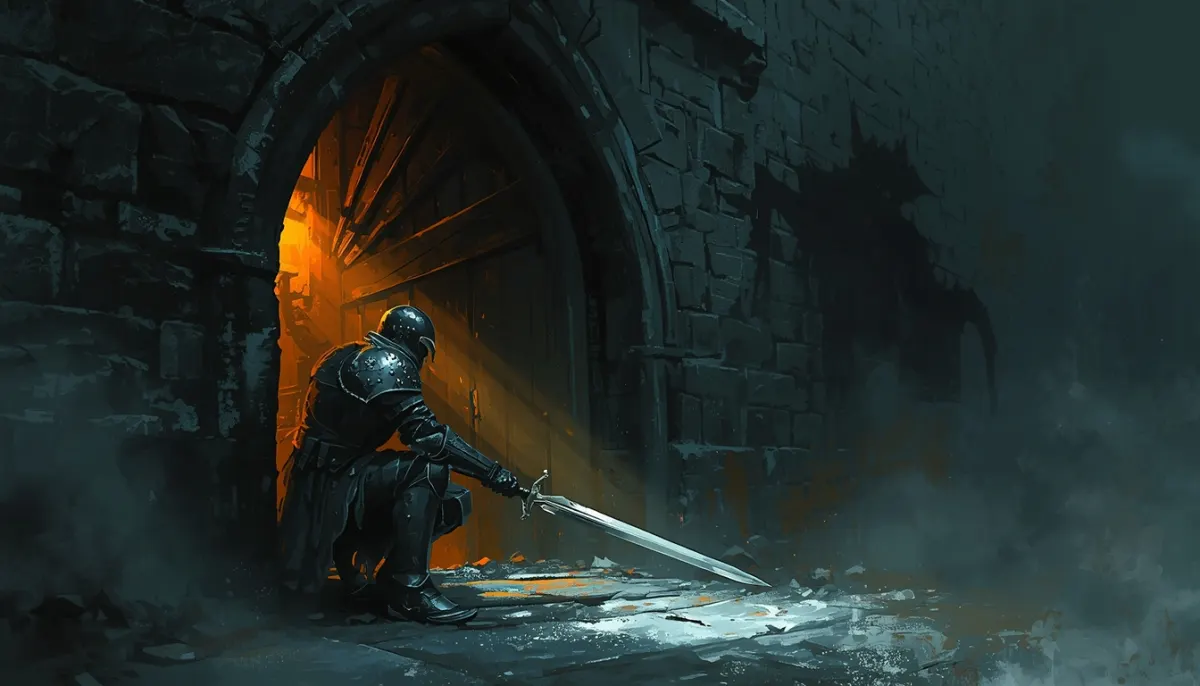
The Ready action lets you name a trigger on your turn, then use your Reaction to act or move when that trigger happens before your next turn. Sometimes the best move on your turn is to wait. The goblin archer ducks behind the wall after every shot. The ogre must come through the one door. The cultist is about to step on the trapdoor. The Ready action lets you hold your action for that moment. It also costs more than it looks. Here is the rule, what it takes from you, and the numbers on when it pays.
The rule
You take the Ready action to wait for a particular circumstance before you act. To do so, you take this action on your turn, which lets you act by taking a Reaction before the start of your next turn.
Two choices, made now:
First, you decide what perceivable circumstance will trigger your Reaction. Then, you choose the action you will take in response to that trigger, or you choose to move up to your Speed in response to it. Examples include "If the cultist steps on the trapdoor, I'll pull the lever that opens it," and "If the zombie steps next to me, I move away."
Then, when it happens:
When the trigger occurs, you can either take your Reaction right after the trigger finishes or ignore the trigger.
Three words carry the rule.
Perceivable. Your hero must be able to notice the trigger. "When the invisible thing moves" fails if nobody can see or hear it.
After. The Reaction lands after the trigger finishes. "When the mage casts a spell, I attack" means the spell goes off first, then you swing. To stop a spell, pick an earlier trigger: "When the mage raises a hand."
Ignore. You choose. If the goblin steps out but the ogre is right behind it, you can let the goblin pass and wait for the ogre. The Reaction stays ready until the start of your next turn.
What it costs
Your Reaction. A readied action spends it:
When you take a Reaction, you can't take another one until the start of your next turn.
So a hero holding a readied swing makes no Opportunity Attack that round. Fire the readied action and the enemy who walks past you afterwards walks free.
Your extra attacks. Every Extra Attack feature in the SRD says the same thing. The Fighter's level 20 version:
You can attack four times instead of once whenever you take the Attack action on your turn.
The readied attack happens on someone else's turn. A level 5 Fighter who readies an attack swings once, not twice.
A spell slot and your Concentration. Readied spells have their own rule:
When you Ready a spell, you cast it as normal (expending any resources used to cast it) but hold its energy, which you release with your Reaction when the trigger occurs. To be readied, a spell must have a casting time of an action, and holding on to the spell's magic requires Concentration, which you can maintain up to the start of your next turn. If your Concentration is broken, the spell dissipates without taking effect.
The slot goes the moment you ready it. If the trigger never comes, the slot is gone. And holding the spell is Concentration, so:
You lose Concentration on an effect the moment you start casting a spell that requires Concentration or activate another effect that requires Concentration.
A Cleric holding Bless who readies Guiding Bolt drops Bless. Damage threatens the held spell too:
If you take damage, you must succeed on a Constitution saving throw to maintain Concentration. The DC equals 10 or half the damage taken (round down), whichever number is higher, up to a maximum DC of 30.
Worked case: the goblin behind the wall
A Goblin Warrior stands behind a low wall. Each turn it steps out, shoots, and uses its Bonus Action:
Nimble Escape. The goblin takes the Disengage or Hide action.
Your level 5 Fighter (+6 to hit, Greatsword 2d6 + 3) cannot see it on your turn, so there is nothing to attack. Ready instead: "When the goblin steps out, I attack it."
Goblin Warrior: AC 15, 10 Hit Points.
| Fighter's choice | Hit chance | Goblin drops |
|---|---|---|
| Attack action, goblin in the open (two swings) | 60% each | 65.6% |
| Ready an attack, goblin steps out (one swing) | 60% | 37.0% |
| Attack action, goblin hidden behind the wall | no target | 0% |
Against a target standing in the open, Ready costs the Fighter almost half the kill chance. Against a target that hides every turn, Ready is the only chance there is. Waiting pays when the enemy would otherwise be out of reach.
Worked case: the Wizard at the door
Goblins are coming through a doorway. A level 3 Wizard (Int 16, spell save DC 13, Con +1, AC 12) readies Burning Hands: "When the first goblin comes through the door, I cast."
The slot is spent now. Each Goblin Warrior fails the DC 13 Dexterity save half the time; on a fail, 3d6 Fire drops it 62.5% of the time. On a success, half damage never reaches 10. Each goblin in the cone drops 31.25% of the time.
But a goblin archer in the next room has a shot at the Wizard before the trigger comes. Its Shortbow (+4) hits AC 12 65% of the time. A hit deals at most 8, so the Concentration DC is 10, and a Con +1 Wizard fails on 1 to 8 on the d20: 40%.
| Archers shooting before the trigger | Burning Hands lost |
|---|---|
| One | 26% |
| Two | 45.2% |
Lose Concentration and the slot is gone with nothing to show for it. Readying a spell works best when nothing can hit you while you wait: out of sight, behind the Fighter, or with a cantrip like Fire Bolt, which risks no slot.
Readied movement
Moving is also allowed: "If the zombie steps next to me, I move away." That movement uses your Reaction, and the Opportunity Attack rule counts it:
You can make an Opportunity Attack when a creature that you can see leaves your reach using its action, its Bonus Action, its Reaction, or one of its speeds.
Stepping away after the zombie arrives still provokes. Ready the move for an earlier trigger, while the zombie is still out of reach: "If the zombie comes within 15 feet, I move back 30."
Good triggers
| Situation | Ready |
|---|---|
| Enemy shoots then hides | Attack when it steps out |
| One door, enemies coming | Burning Hands, or an attack, when the first one is in the doorway |
| Ally about to open a trapped chest | Move next to the ally when the lid lifts, to catch them |
| Enemy caster | Attack when it raises a hand or starts speaking, not when it casts |
| Escaping a slow monster | Move away when it comes within its Speed of you |
Keep triggers short and something the hero can see or hear. Say the trigger and the action out loud at the table, so nobody argues later.
For everything else that fits in a turn, see your turn in combat. For the cheaper ways to stay safe, see Dodge, Dash or Disengage, and for holding a spell under fire, Concentration.
This work includes material from the System Reference Document 5.2.1 ("SRD 5.2.1") by Wizards of the Coast LLC, available at dndbeyond.com/srd. The SRD 5.2.1 is licensed under the Creative Commons Attribution 4.0 International License.